
Reviewed · HERCULANEUM TOURS
Herculaneum Small Group Tour and Ticket With an Archaeologist
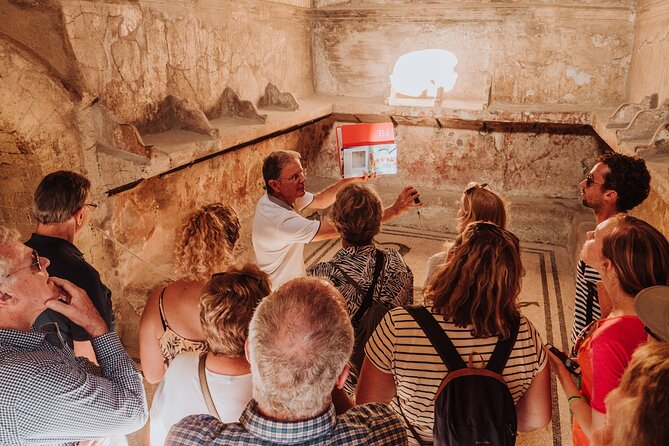
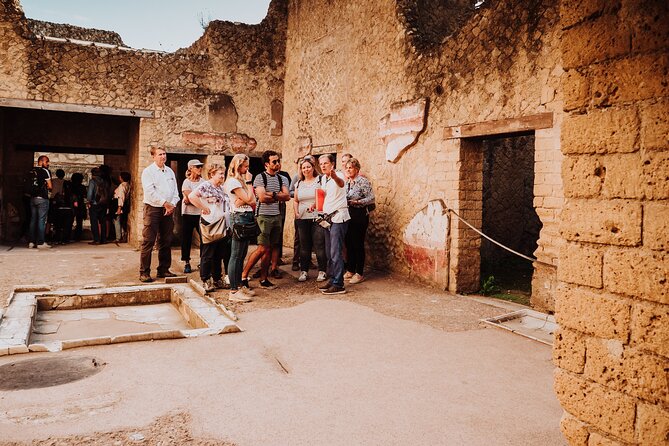
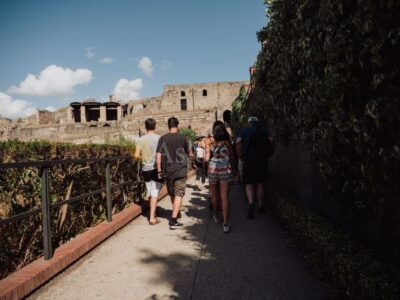
Herculaneum is fascinating because it gives you a close look at daily life inside preserved houses and bath spaces, not just a pile of stones. This tour pairs that walk through the ruins with an archaeologist guide who can explain what you are actually seeing. You get to move fast enough to hit the highlights, without feeling like you are just being herded.
I really like two things here. First, the small group size matters. With a maximum of 20 people, the pace stays manageable, and you can hear explanations through the included headsets. Second, the tour bundles the skip-the-line entry ticket, so you are not burning your limited time waiting outside.
One thing to consider is that it is a walking tour with lots of standing. Even though each stop is only around 10 minutes, your comfort depends on how you handle moving around and viewing close-up details.
Key Things You Will Love About This Herculaneum Tour
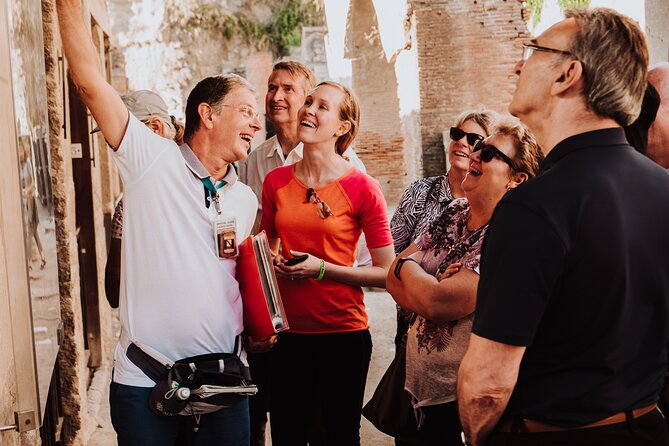
- Max 20 people plus headsets so you can actually keep up with the stories and directions
- Archaeologist-led interpretation that turns rooms, inscriptions, and materials into context
- A stop-by-stop loop through villas, baths, and the kinds of wooden and marble details people missed alone
- Central Thermae’s separate men and women bath layout that helps you picture daily routines
- Clear, practical meeting point at the Ticket Office area, ending inside the ruins
- Time-efficient highlights in about two hours, with the option to extend your day on your own
Meeting at the Ticket Office in Ercolano, Then Walking Straight In
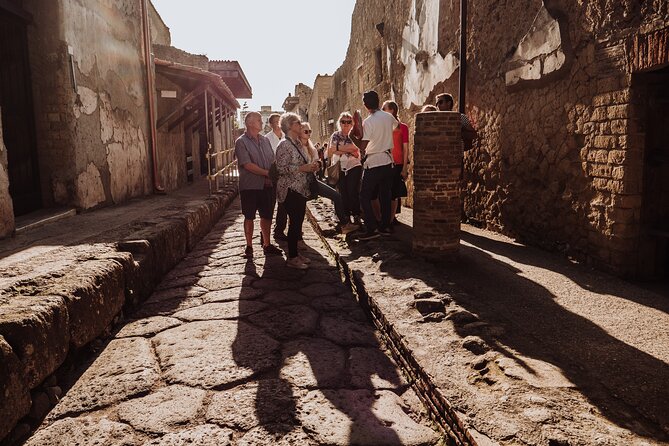
The tour starts at the ticket office for the Herculaneum ruins, with the meeting address listed as Corso Resina 187, 80056 Ercolano NA. After that meetup, you walk through the site and the tour ends inside the ruins, so you are not left trying to figure out where to go next.
Getting there is fairly straightforward. If you drive, there is unguarded parking nearby in via Pignalver. If you use public transit, take the Circumvesuviana and plan on about a 10-minute walk from the station near Corso Resina 1.
Tip for your first minutes: arrive early enough to settle in before the group gathers. The tour is about moving through the site efficiently, and the guides work best when everyone starts together.
More Herculaneum tours in Naples:
- Herculaneum: Skip-the-Line Guided Tour with Archaeologist
★ 4.8 · 3,439 reviews - Herculaneum: Skip-the-Line Entry Ticket with Audio Guide
★ 4.3 · 870 reviews - From Naples: Pompeii & Herculaneum with Archaeologist Guide
★ 4.8 · 665 reviews
A 2-Hour Small-Group Format That Moves at a Realistic Museum Pace
This experience is scheduled for about 2 hours. That is a sweet spot for Herculaneum, because you will see multiple major houses and baths without feeling like you need a full day to get the core ideas.
Group size is capped at 20 people, and headsets are included. That means the guide can keep a steady pace, and you are not stuck constantly asking someone to repeat themselves. In the comments you can also see this attention to hearing and clarity in action, including guides who check that people with hearing aids can follow along.
The trade-off is movement. You should expect a lot of standing and walking, with limited chances to sit. If you have mobility limits, I would treat this as an “active ruins” tour, not a relaxed stroll.
What You See in Herculaneum: Houses, Baths, and the Clues in the Materials
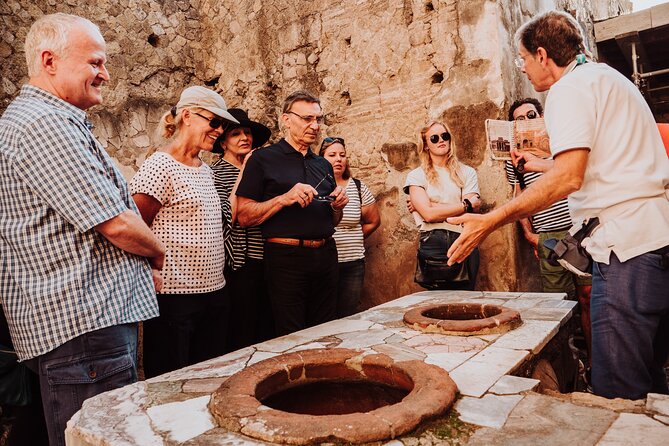
The itinerary is built around a classic Herculaneum loop. You will spend short focused bursts at each stop, then keep moving so you cover both the impressive spaces and the everyday architecture.
Here is what you can expect, stop by stop.
House of the Deer, Named for Stags in the Peristyle
This stop gets its name from marble statues of stags or deer found in the peristyle. What I like about starting here is that it shows how archaeologists connect art objects to the layout and use of a home.
Look beyond the name and ask yourself how display pieces would have worked in a lived-in space. A guide helps you picture how a peristyle functions as a social and visual center, not just a courtyard.
A few more Naples trips worth comparing
- Naples: Catacombs of San Gennaro Entry Ticket & Guided Tour
★ 4.6 · 7,941 reviews - Naples: Downtown Tour with Veiled Christ & St Clare Tickets
★ 4.9 · 6,462 reviews - Naples: Hop-on Hop-off Bus Tour 24-Hour Ticket
★ 4.3 · 5,157 reviews - Mount Vesuvius: Skip-the-Line Ticket and Smart Digital Guide
★ 4.2 · 2,780 reviews
La Terrazza di M. Nonio Balbo, and How Inscriptions Anchor the Story
M. Nonius Balbus was a major benefactor in the city, restoring and building public buildings. On his death, he was honored with details recorded in a long inscription on his funeral altar.
This is a useful stop because it links private life to public status. When you can read the idea behind the inscription, the stone stops being decorative and starts acting like a historical document.
College of the Augustales, Cult and Civic Life in One Building
This building is thought to relate to the cult of Emperor Augustus, and possibly to the headquarters of the Collegium Augustalium, or even the local curia. In plain terms, it is where religious and civic identity would have overlapped.
I like this stop because it broadens Herculaneum beyond houses. You get a sense that the city’s everyday life had organized public rituals and local governance woven in.
Casa del Rilievo di Telefo, a House with Access to the Suburban Thermae
Casa del Rilievo di Telefo is tied to a leading benefactor, with the clue pointing toward Marcus Nonius Balbus. It is also unusual because it has private access to the adjoining Suburban Thermae to the south.
That private access detail is a great reality check. It tells you that bathing was not just a public service, and that social rank could affect how spaces were connected.
Partem Domus lignea, the Wooden Partition That Still Matters
This stop highlights an important element: the elegant wooden partition that has remained. Even though the visible structure is fragmentary, the guide can explain why wood pieces are so crucial for understanding how rooms were divided and used.
If you only look at the stone, you will miss the point. This is one of those stops where you want to slow down mentally and think, What did people use this room for, and how did partitions shape daily movement?
House of the Skeleton, Named from Human Remains Found in 1831
It gets its name from discoveries of human remains in a second-floor room in 1831. This is a heavy stop, and it is also an example of how archaeology uses both architecture and finds to explain the site’s story.
The best way to handle this emotionally is to focus on the concrete details you are given: the room context, the naming origin, and how archaeologists interpret what they find.
Central Thermae, Built Early in the 1st Century with Separate Baths
The Central Thermae were built around the beginning of the 1st century AD. They were divided, in the usual practice of the time, into men’s and women’s baths, each with separate entrances.
This stop is a highlight for anyone who likes practical history. It helps you visualize how routines were organized. Instead of vague ideas about bathing, you see the architectural logic behind privacy and separation.
House of the Black Salon, a Luxurious Mansion with Carbonised Door Posts
The House of the Black Salon is one of Herculaneum’s more luxurious mansions. It has a monumental entrance, and you can still see carbonised remains of the doorposts and lintel.
I love stops like this because they are tactile. Even if you cannot touch anything, you can see how wood and stone elements survived in ways that reveal use and design.
Casa Sannitica, Samnite Layout with an Atrium and Ionic Columns
Casa Sannitica is arranged in a way thought to be typical of the Samnites. The atrium is skirted by a gallery with Ionic columns, and the rooms are decorated with frescoes.
This stop helps you compare styles. A good guide points out how architecture reflects identity, not just aesthetics, and how columned galleries signal both status and movement within the home.
Casa del Bel Cortile, the Courtyard with a Stairway and Stone Balcony
This is one of Herculaneum’s more original houses, with a courtyard that includes a stairway and a stone balcony instead of an atrium. It is the kind of feature that makes you pause, because it changes the whole feel of how the space would have worked.
I would pay attention to how a stair and balcony shape who sees who. A guide can connect that design to everyday social life.
House of the Grand Portal, Central Domus with Frescoes and Charred Wooden Parts
The House of the Grand Portal sits in the centre of the archaeological area. It includes various environments, colonnati, frescoes, and charred remains of wooden parts.
This is a strong closing stop because it ties together what you have been learning. You are not just collecting isolated details; you are seeing how the parts combine into a full home experience.
Why the Archaeologist Guide Changes Everything
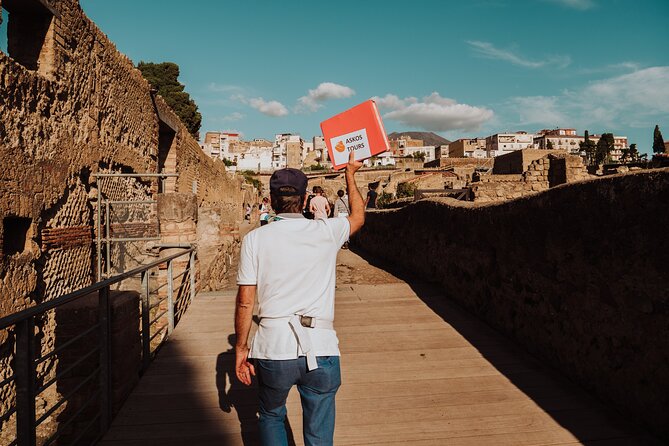
If you like history that feels usable, this is where the tour earns its keep. The archaeologist guide does more than name buildings. They connect architecture, finds, and inscriptions into a story you can picture while you stand there.
Several guides are singled out for doing this in a way that sticks. Michaele is noted for weaving in engineering and cultural history alongside personal and family stories. Luciano Leone is praised for being a working archaeologist, with explanations that include visual reconstructions created to show how buildings might have looked in their original state.
Paulo is described as highly informative and passionate, with clear pacing that still covers a lot of ground. Julia earns strong marks for English that is easy to follow, plus authority and enthusiasm that make the site feel alive rather than academic.
One practical detail matters too: hearing equipment works. People mention that headsets help everyone follow clearly, and one guide regularly checked that a guest with hearing aids could hear well.
There is one caution worth noting. On at least one occasion, a guide ran overtime and that reduced time for the onsite museum. So if you care about squeezing in museum browsing right after the tour, keep your schedule flexible and do not book yourself into something time-critical.
Tickets and Price: What You Actually Get for $53.81
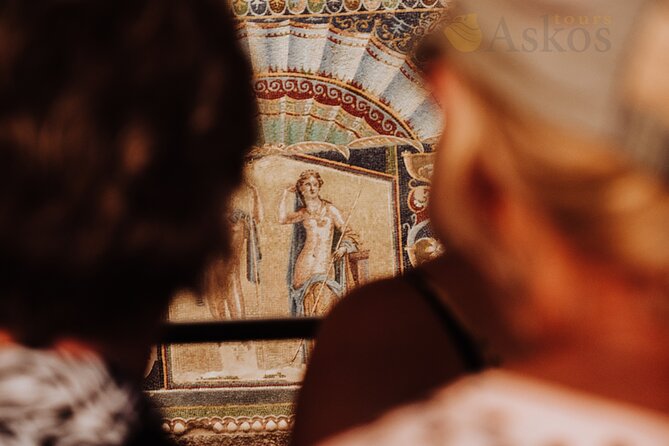
The tour price is $53.81 per person, and it includes the Herculaneum entry ticket. You are also given headsets and guidance from a licensed guide with archaeological background.
That matters for value, because the adult park entry ticket is listed at 16 euros. This tour is not just a “talking walk.” It is a guided access package with the on-site listening gear that helps you get more from every stop.
If you are comparing to a DIY day, I think the key is time. Herculaneum rewards looking closely, and the guide makes that looking easier by pointing out what to watch for, why it was used, and how it connects to what came before.
Practical Tips So Your 2 Hours Feel Great
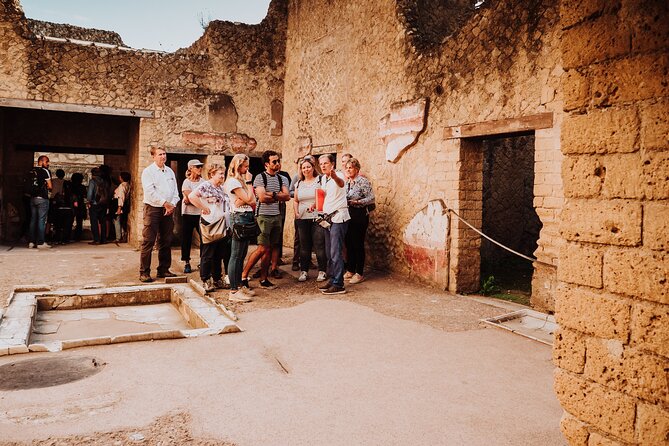
Here are the things I would plan for so the tour feels smooth.
- Wear comfortable shoes. You will be on your feet a lot, and the stops are short.
- Dress for weather. The tour operates in all weather conditions, and rain has happened in at least one experience.
- Use the headsets properly. This is not a gimmick. It is what makes the pace workable, especially in busier moments.
- Give yourself buffer time. If you want museum time after, assume you may not get a perfectly timed finish.
- If hearing is an issue, tell the guide early. Some guides are attentive about ensuring you can hear the explanation.
- Bring a plan for dogs. Dogs are allowed in the park with leash or muzzle and bags for droppings. Inside the Antiquarium, Boat Pavilion, and any domus with mosaic floors, dogs must be carried or transported in an appropriate carrier.
For families: a small-group structure and clear guidance can work well, and at least one family with teens enjoyed the mix of houses and baths.
Should You Book This Archaeologist Tour of Herculaneum?
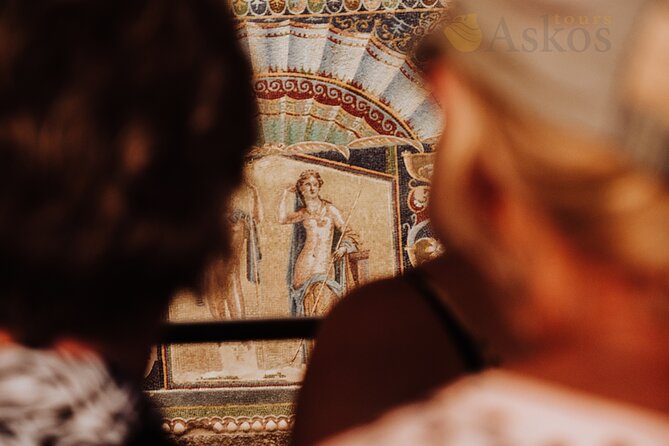
Book it if you want Herculaneum to make sense fast. This is a strong choice for first-timers, people who do not want to guess at architectural clues, and anyone who appreciates standing in a real space while a guide connects the dots.
Skip or reconsider if you strongly prefer self-paced wandering. The walking element is real, and if you get impatient with a guide-led pace, you may feel rushed. Also, if museum time is the top priority for you, build in flexibility because timing can vary based on how the tour unfolds.
My take: for the price, the combination of guided interpretation, small-group limits, and headsets is what turns the ruins into an understandable experience, not just a scenic detour.
FAQ
Where does the tour start?
The meeting point is at the Ticket Office of the Herculaneum ruins. The provided start location is Corso Resina 187, 80056 Ercolano NA, Italy.
How long is the tour?
The duration is approximately 2 hours.
Is the entrance ticket included?
Yes. The tour includes the Herculaneum entry tickets, and headsets are also included.
What do we see during the walking route?
You will visit multiple highlights including the House of the Deer, La Terrazza di M. Nonio Balbo, the College of the Augustales, Casa del Rilievo di Telefo, Partem Domus lignea, the House of the Skeleton, Central Thermae, the House of the Black Salon, Casa Sannitica, Casa del Bel Cortile, and the House of the Grand Portal.
Is the tour offered in English?
Yes, the tour is offered in English.
Can I bring a service animal or a dog?
Service animals are allowed. Dogs are allowed at the Herculaneum Archaeological Park with leash or muzzle and you must carry bags for droppings. Dogs may need to be carried or transported in a carrier in the Antiquarium premises, the Boat Pavilion, and domus featuring mosaic floors.
What is the cancellation policy?
Free cancellation is available up to 24 hours in advance for a full refund. If you cancel less than 24 hours before the experience starts, the amount paid is not refunded.
Recently reviewed around Naples
- From Naples: Pompeii & Mount Vesuvius Full-Day Private Tour★ 4.5 · 4 reviews
- Pompeii with Wine Tasting Private Tour★ 4.7 · 6 reviews
- Pompeii, Amalfi, Ravello Day Tour with Private Transfer★ 5.0 · 3 reviews
- Ruins of Pompeii & the Amalfi Coast: Full-Day Private Tour★ 5.0 · 7 reviews
- Pompeii and Herculaneum: Private Tour from Naples★ 4.6 · 12 reviews
- From Naples: Pompeii Private Tour with Transfer and Guide★ 4.7 · 23 reviews
- Pompei: Private tour of Pompei and Vesuvius from Sorrento★ 5.0 · 8 reviews
- Pizza lesson★ 5.0 · 3 reviews
Herculaneum Tours, compared.

Pompeii and Herculaneum Small Group Tour with an Archaeologist
Read our review →
Pompeii & Herculaneum with Archaeologist Guide
Read our review →
Pompeii, Herculaneum, & Vesuvius Full-Day Tour
Read our review →
Ercolano: Herculaneum Entry Ticket with Optional Audio Guide
Read our review →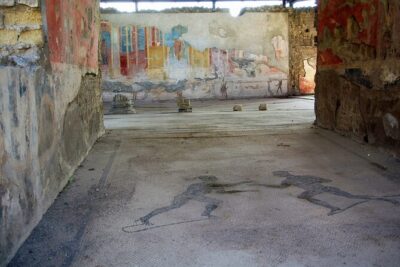
Day Trip of Pompeii, Herculaneum and Vesuvius from Naples
Read our review →Browse the lists this tour appears in