
Reviewed · POMPEII TOURS
Pompeii 3-Hour Walking Tour
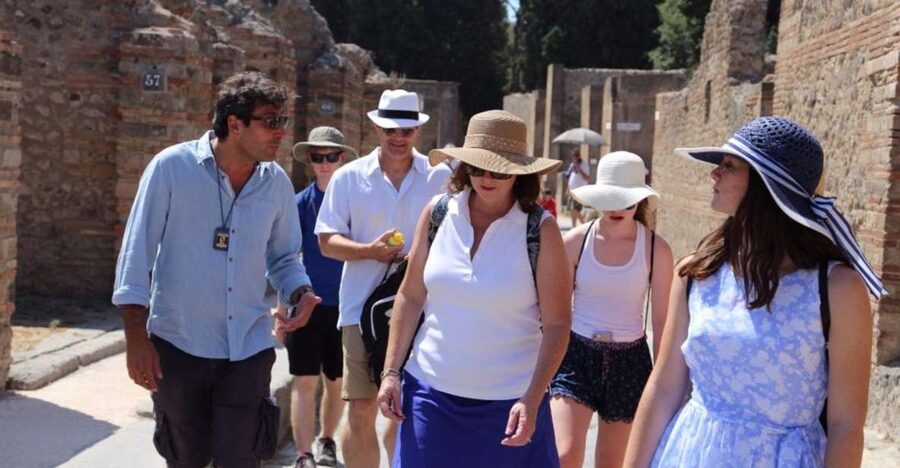
Pompeii is interesting for one big reason: it lets you walk through a Roman city that froze in time the moment Vesuvius buried it under ash and lava. On this private 3-hour walking tour, you get a guided path through the main ruins, with expert context that turns stone walls into daily life.
I especially like the focus on high-impact sights, from the Forum to the Lupanar brothel. I also like that you do not just see structures, you learn how Pompeii was rediscovered in the 18th century and why that matters.
One consideration: this is a walking tour that runs in any weather, and umbrellas are not allowed. Plan on rain with a raincoat, not a handheld umbrella.
Key things you will love about this Pompeii tour
- Private, guided pacing through the biggest Pompeii landmarks in about 3 hours
- Skip the ticket line while still getting Pompeii admission included
- Archaeologist-style explanations that connect public spaces and private homes
- Plaster casts of humans and animals, showing what happened at the time of death
- Real Pompeian life stops, including baths, a bakery, and a termopolium
- Multilingual guide options, including English plus many other languages
Pompeii, guided in 3 hours, with the story that makes it click
If Pompeii feels overwhelming on your own, this is the kind of tour that fixes that. A private guide does not just list buildings. They explain how the Roman city worked, where people gathered, where they ate, where they bathed, and what the eruption changed in a single violent moment.
I like that the tour keeps the route tied to the most meaningful ruins. You are not left wandering from one highlight to the next without a point. Instead, you move through classic anchors like the Forum and civic areas, then shift into daily-life zones like homes, baths, and the brothel.
The best part is the human scale. Pompeii does not stay abstract when you are shown the plaster casts of people and animals from the time of death. Even if you know the story of 79 A.D., seeing the evidence, in context, makes the disaster feel real.
More Pompeii tours and tickets in Pompeii Archaeological Site:
- Pompeii: Entry Ticket with Optional Audio Guide
★ 4.2 · 12,360 reviews - Pompeii: Archaeological Park Tour with Ticket on request
★ 4.5 · 2,283 reviews - Pompeii Ruins Private Tour with Optional Skip-the-Line Entry
★ 4.9 · 732 reviews
Price and value: what your Pompeii admission plus private guide includes
The price is listed per group, up to 1 person, at $508.15 for this private format. That sounds high until you look at what you are actually buying: private guidance plus Pompeii admission fees included, and a plan that targets major sights in a set time.
If you are the kind of visitor who hates wasting hours in ticket lines or accidentally skipping the best areas, this can be good value. You are paying for time saved and for interpretation that you likely would not get if you simply hired an audio guide and tried to figure it out alone.
You should also think about language. With multiple available guide languages, you can get the archaeology explanations in the language you are most comfortable with, which is often the difference between a quick visit and a memorable one.
Before you go: meeting points, what to bring, and the rules that matter
This tour is designed as a walking experience, and it runs in any weather condition. Starting times vary, so check availability when you book.
For the meeting point, you have two Via Villa dei Misteri options listed, and the exact start location depends on what you book. The tour ends back at the meeting point, so you do not need to plan a separate pickup.
Bring a passport or ID card. The tour also has clear rules: no pets (assistance dogs are allowed), and no umbrellas and no backpacks. For rain, do not rely on an umbrella. A raincoat is the safer choice with these rules in mind.
Wheelchair accessibility is listed, and the group is private, which generally helps with pacing.
Your stop-by-stop route through Pompeii’s public life and private rooms
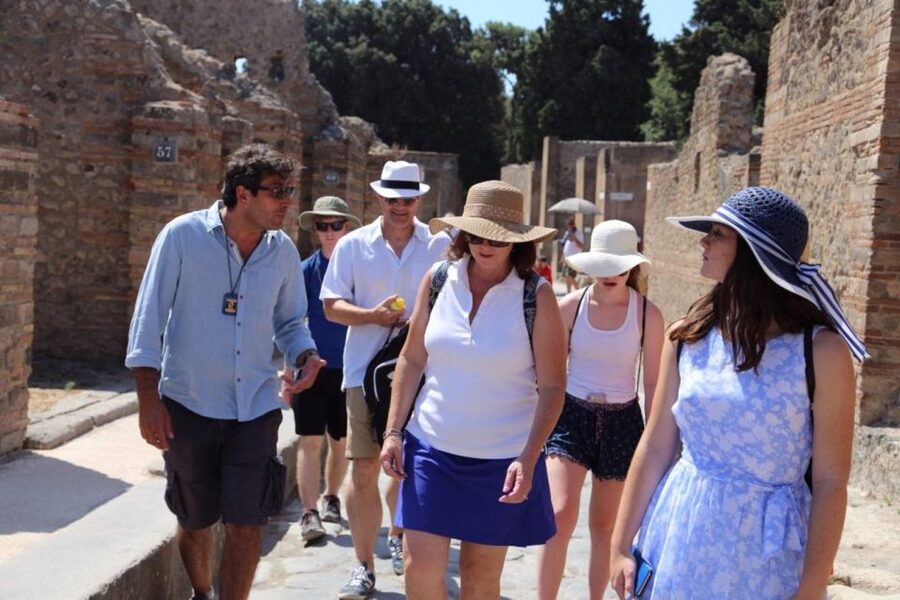
The itinerary is set up as a guided walk through big highlights, with multiple stops that build your understanding as you go. Below is how the experience feels stop by stop, and what each place teaches you.
More walking tours in Pompeii Archaeological Site:
- Naples: Street Food Walking Tour with Local Guide
★ 4.8 · 4,256 reviews - Pompeii: Guided Walking Tour with Entrance Ticket
★ 4.3 · 1,423 reviews - Naples Spanish Quarters Walking Tour Street Art, Folklore & Sweet
★ 5.0 · 797 reviews - Naples: Old Town Guided Walking Tour
★ 4.8 · 553 reviews
Starting out at the Via Villa dei Misteri meeting points
Your tour begins at one of the Via Villa dei Misteri meeting locations. This is a helpful way to start because Pompeii works best when you get your bearings early, before the ruins start to blur into one another.
From the start, your guide’s job is to frame what you will see in the next few hours: Roman civic life, everyday routines, and the eruption aftermath that turned the city into an archaeological time capsule.
Pompeii Archaeological Site: your orientation on what the eruption changed
At the Pompeii Archaeological Site, the guide sets the scene for the walk. You are taken through the key story of Pompeii being buried under ash and molten material after Vesuvius erupted in 79 A.D. The goal is to help you understand what you are looking at, not just where it is.
You will also learn about Pompeii’s rediscovery in the 18th century, and why that matters. The rediscovery is part of the reason you are able to visit the site in a way that feels so vivid today.
As you move through the ruins, the guide ties the Roman Republic and early empire context to specific structures, so you can connect names on the map with the way people lived.
Porta Marina, also called the Marina Gate: arriving into the city
Next up is Porta Marina. This is a major entry point, and it is a natural place to start thinking like a resident or a visitor in ancient times. City gates mattered, and they shaped how people entered, moved around, and accessed key areas.
Your guide uses the location to talk about how urban planning worked, then transitions you toward the civic core.
Villa of the Mysteries: walking through an intense house
The Villa of the Mysteries is famous, and your guide will help you make sense of why. Even if you only spend a short time here, it tends to leave people with questions, because it feels different from the more public streets and civic spaces.
This stop is a good reminder that Pompeii was not only temples and marketplaces. It was also private religious and social life, played out on the walls of homes.
Temple of Apollo and the religious layer of the city
At the Temple of Apollo, you get into the religious side of Pompeii. Your guide connects how worship was part of city identity, not something tucked away in the background.
The tour also highlights temples like Jupiter, Apollo, and Venus, so you get a sense that different gods and different spaces carried different roles. These stops make Pompeii feel less like a ruin park and more like a working city in its own time.
Foro Civile di Pompei and the Forum Baths area: politics, courts, and public routines
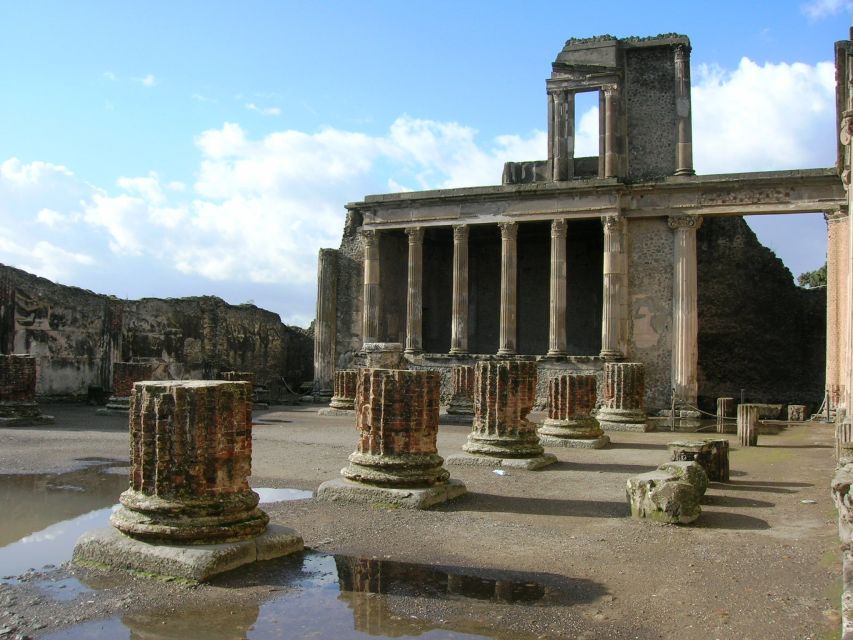
When you reach the Foro Civile di Pompei, you are in the heart of civic authority. This is where you start understanding the Roman obsession with public institutions, even when you are standing in an empty courtyard.
Right alongside this area, you will also visit the Basilica (court house). That matters because the Basilica helps you imagine how people gathered for legal and civic processes.
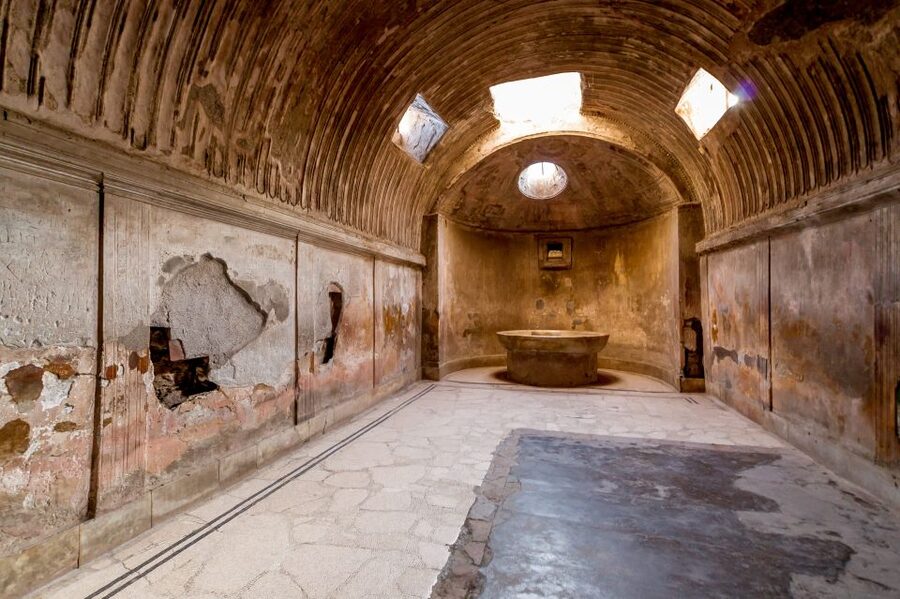
Nearby, you get bath culture through the Sarno Baths and Forum Baths stops. Baths were not only about washing. They were social infrastructure. In a short tour, they are one of the best ways to see how daily routines played out in shared spaces.
Triangolar Forum, Teatro Grande, Odeion: the civic side of entertainment
As the route moves, you may encounter the Triangolar Forum and head toward the theatre zone, including the Teatro Grande and the Odeion (small theatre). These stops are where Pompeii turns from administrative life to public performance and crowd energy.
The guide’s explanations are key here. Without context, a theatre can look like a pretty shell. With it, you learn how performances fit into the city’s rhythm, and why these buildings were built to handle audiences.
House of Menander and House of the Faun: private wealth with a human viewpoint
Two major homes on the route are the House of Menander and the House of the Faun. These stops help you shift your perspective from city-wide spaces to how households organized daily life.
Even in a brief visit, homes like these give you clues about status, taste, and routine. You also start seeing how Pompeii’s public and private worlds connect, since the same city that hosted civic gatherings also supported a range of domestic lifestyles.
House of the Vettii and House of the Tragic Poet: art and identity in domestic spaces
Later you visit the House of the Vettii and the House of the Tragic Poet. These are ideal stops for thinking about how Roman identity showed up in homes, through decoration and layout.
The guide helps you connect what you see to how people thought about themselves. It is not just architecture. It is a window into values, relationships, and daily habits.
Lupanare: the old brothel and what it reveals about everyday society
The Lupanar stop is one of the most striking parts of the tour. Your guide frames it in a way that feels informative rather than sensational.
This is where you learn about Pompeii as lived-in society, including spaces tied to commerce and human relationships. It also helps you understand how the city’s public structure and private activities overlapped.
Along the route, the tour may also include related everyday-life highlights like a bakery and a termopolium, including Termopolium Capuano. These are excellent reminders that Pompeii was not only temples and monuments.
Plaster casts: the moment the disaster becomes personal
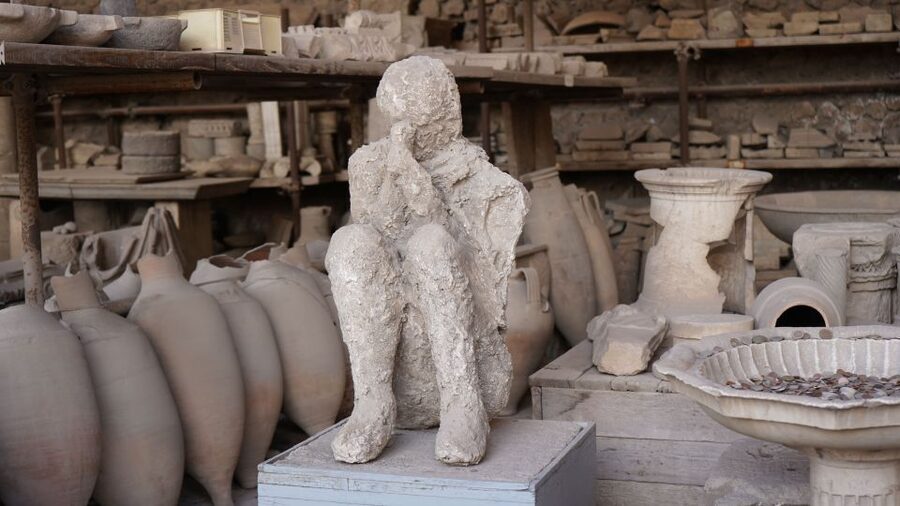
Somewhere in the walk, you see the plaster casts of humans and animals preserved from the time of death. This is the emotional anchor of the entire tour.
I like the way the guide handles this. You are not left staring at replicas with no meaning. You get context so the casts feel like evidence, not just horror for the sake of it.
This stop is where you understand why Pompeii and Herculaneum were inscribed as World Heritage sites. The idea is that you get a complete, vivid picture of society and daily life at a specific moment in the past, something rare and hard to reproduce.
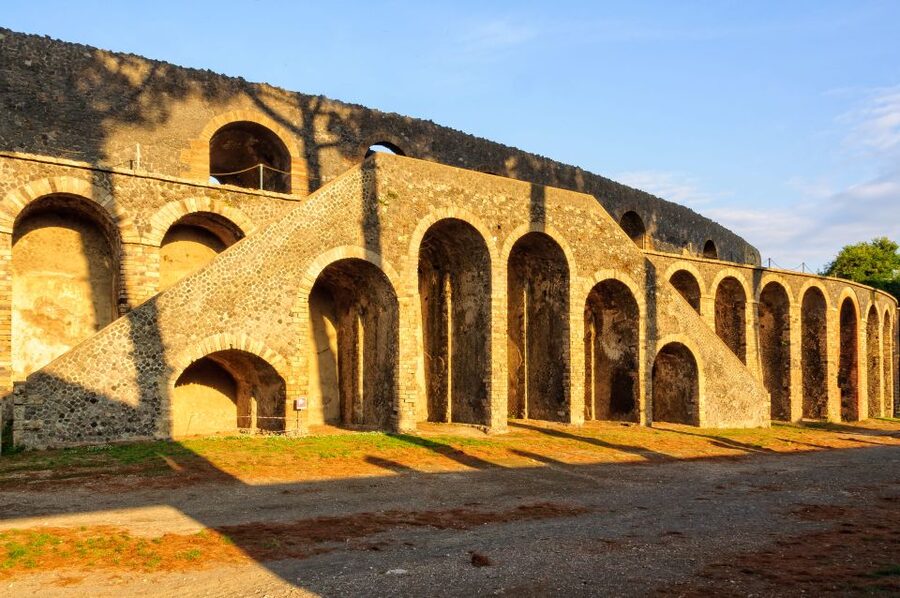
Large Theatre and the Amphitheater of Pompeii: spectacle at city scale
The tour also includes the Large Theatre and the Amphitheater of Pompeii. These are where crowds, performance, and spectacle take center stage.
With a guide, you can notice the practical design elements that made these places work for audiences. Without guidance, you might just feel like you are looking at seating and stone. With guidance, you start seeing the system.
Finishing back at the meeting point
After the last major sight, your tour wraps back at the meeting point. That structure is useful. It keeps your time clean and prevents the common problem where you wander farther than you planned and miss key areas.
The guide factor: why an archaeologist-style tour usually hits harder

The reviews highlight two things that matter: the tour guide competence and the ability to keep the experience entertaining. That combination is not accidental. Pompeii can be hard to understand without help, and a good guide makes complicated details feel clear.
One named example you might be lucky enough to get is Vincenzo, described as an archaeological guide who is both very knowledgeable and friendly. If your tour includes someone with that kind of delivery, you will likely appreciate the way the explanations connect daily life to the spaces you are walking through.
Your guide can speak multiple languages, including English, Italian, Spanish, German, Russian, Chinese, Japanese, and Portuguese. That multilingual element is a real quality-of-life benefit in Pompeii, because the city is dense and you want your guide’s explanations to land fast.
Who this Pompeii tour is best for
This tour is a strong match if you:
- Want major Pompeii highlights in a short time window
- Prefer a private group format over joining a larger crowd
- Want expert interpretation, including the story behind ash, lava, and rediscovery
- Care about seeing both civic spaces (Forum, courts) and daily life (baths, bakery, termopolium, homes)
- Like the idea of the plaster casts as an evidence-based moment rather than a vague legend
It may be less ideal if you want a slow, unstructured roam where you can spend long stretches on just one neighborhood. This is a set route with a set time, designed to cover a lot without wandering.
Quick practical notes on logistics and comfort
This is scheduled as a 3-hour tour, and it works in any weather. You are also limited by site rules on personal items: no umbrellas and no backpacks. If you are traveling light, you will probably enjoy the flow more.
The tour is wheelchair accessible, and because it is private, your guide can tailor the pace within that time frame.
Should you book this Pompeii 3-hour walking tour?
I would book it if you want the best odds of leaving Pompeii feeling like you understood what you saw, not just that you walked around ruins. The private format, admission included, and the emphasis on major landmarks plus the plaster casts make this a smart choice for first-time Pompeii visitors or anyone short on time.
You might skip it if your priority is freedom to explore without a structured route, or if you already know Pompeii well enough to navigate efficiently on your own. But if you want a guided story that brings the Roman city to life, this is one of the cleaner ways to do it in only a few hours.
FAQ
How long is the Pompeii 3-hour walking tour?
The tour duration is 3 hours. Starting times can vary, so you will need to check availability when booking.
Is this a private tour?
Yes. It is listed as a private group.
What is included in the price?
The tour includes private guidance and Pompeii admission fees.
Does the tour include skipping the ticket line?
Yes. Skip-the-ticket-line access is listed as part of the experience.
Which languages are available for the live guide?
The live guide languages listed are Spanish, German, Russian, Chinese, English, Italian, Japanese, and Portuguese.
What should I bring, and what is not allowed?
You should bring a passport or ID card. Pets are not allowed (assistance dogs allowed), and umbrellas and backpacks are not allowed.
Is the tour wheelchair accessible?
Yes. Wheelchair accessibility is listed as available for this activity.
Recently reviewed around Pompeii Archaeological Site
- Pompeii: Skip-the-Line Ticket and Virtual Museum★ 4.5 · 66 reviews
- Mount Vesuvius Wine Tasting and Lunch from Pompeii★ 4.3 · 43 reviews
- From Sorrento: Pompeii and Vesuvius Tour by Express Train★ 4.0 · 12 reviews
- From Naples: Pompeii & Sorrento Shore Excursion with Lunch★ 5.0 · 6 reviews
- Pompeii: Tour for Children★ 4.7 · 106 reviews
- Pompeii 2-Hour Private Tour★ 4.9 · 121 reviews
- Pompei: Pompeii and Vesuvius Combo with Transfer and Tickets★ 3.9 · 130 reviews
- Pompeii: Archeological Tour & Wine Tasting at Mt. Vesuvius★ 4.6 · 142 reviews
Pompeii Tours, compared.
Entry Ticket and Guided Tour with an Archaeologist
Read our review →


Pompeii Small Group Tour with an Archaeologist
Read our review →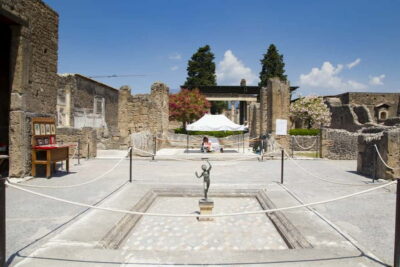
Naples or Sorrento: Full-Day Pompeii and Mount Vesuvius Tour
Read our review →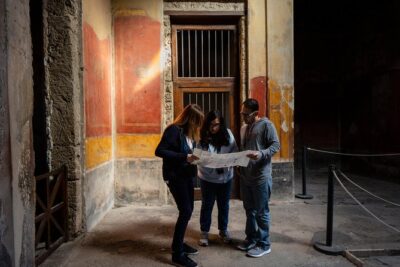
Pompeii & Mt.Vesuvius Day Tour from Naples with Pizza Lunch
Read our review →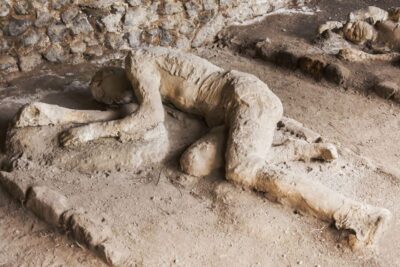
Browse the lists this tour appears in