

Reviewed · POMPEII TOURS
Pompeii Small Group Tour with an Archaeologist
This 2-hour Pompeii walk with an archaeologist is interesting because it turns a famous ruin field into a guided story about everyday life and sudden disaster. I love the Pompeii Express skip-the-line start, and I love how the route is built around clear architectural stops that help you picture the city. The one drawback to plan for is simple: you only see a slice of Pompeii, so you will likely want more time here after the tour.
The best part of this experience is the human scale. With a maximum group size of 20, you get a guide who can actually answer questions, and for larger groups you wear headsets so you do not strain your voice. Guides like Alessandra, Paolo, and Vincenzo are praised for making Pompeii feel personal, with pacing that keeps the story moving instead of turning into a textbook slideshow.
Small-group format (max 20) with headsets for bigger groups so you can hear the guide without crowding.
Skip-the-line Pompeii Express entry gets you inside fast at the start.
Granai del Foro plaster casts include striking victim casts, plus details like a dog and a tree.
A smart “big map” route through the Basilica, Forum, Menander, Stabian Baths, and the Brothel area.
Public life at the end with the Teatro Piccolo viewpoint and the Teatro Grande interior.
You finish inside the ruins, which makes it easier to keep exploring on your own right after.
Pompeii with an archaeologist guide: what changes and why it matters
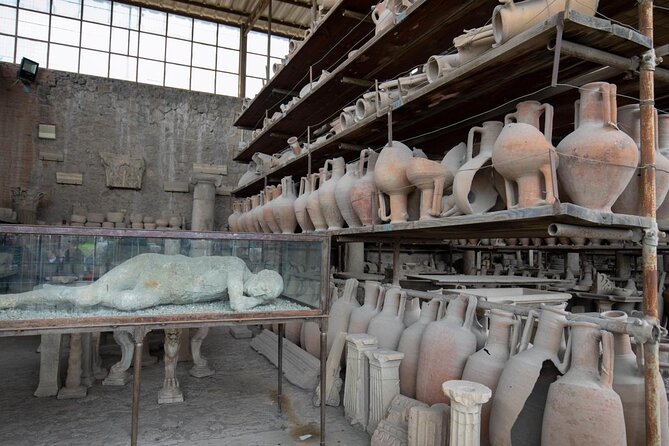
Pompeii is one of those places where it is easy to feel overwhelmed. Streets and buildings sit in front of you, but without a guide, it can take a while to learn what you are looking at. This tour helps you start “seeing” Pompeii quickly by using the city’s own landmarks as a roadmap.
What makes the archaeologist angle work is that you do not just hear facts. You get context for how Romans used space. The tour pauses at the places that show power, work, worship, leisure, and home life, then connects them to the eruption that froze Pompeii in time.
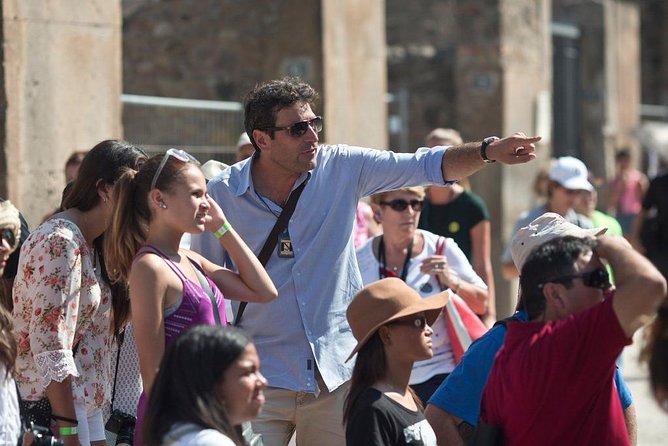
You also get the storytelling style that many guides on this route are known for. People mention humor, patience with questions, and pacing that fits real bodies and real walking tolerance. That matters on an archaeological site where uneven ground and sun can slow you down more than you expect.
Price and time: is about $35.67 actually good value?
At $35.67 per person, you are paying for three things that add up in Pompeii: a guide with an archaeological background, a small-group setup, and an included entrance product called Pompeii Express.
You are not paying for a luxury experience. This is a two-hour walking tour with a set path, and it is designed to help you get oriented without spending the entire day trapped in “tour mode.” If you are visiting Pompeii for the first time, two hours is a sweet spot. You get the highlights that most people want, but you still have time after the tour to wander more freely.
If you already know Pompeii well and you like to move at your own pace with no scheduled stops, you might feel the time limit. But for most first-time visitors, the value is that the guide helps you interpret the stones you would otherwise skim.
More Pompeii tours and tickets in Pompeii:
- Pompeii: Entry Ticket and Guided Tour with an Archaeologist
★ 4.8 · 19,459 reviews - Pompeii: Entry Ticket with Optional Audio Guide
★ 4.2 · 12,360 reviews - Pompeii: Small Group Tour with an Archaeologist
★ 4.8 · 12,264 reviews
Meeting at Via Villa dei Misteri, then heading into Porta Marina Superiore
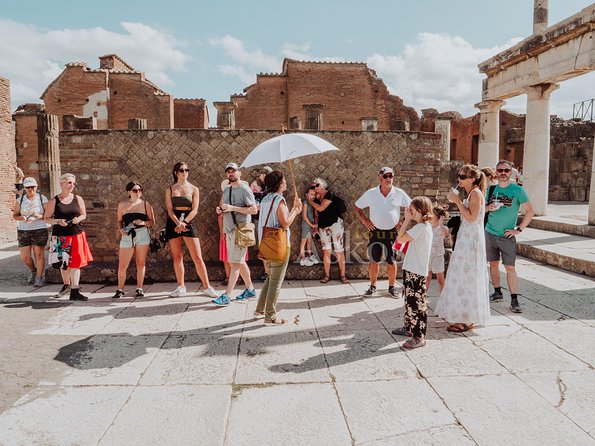
The tour starts at Via Villa dei Misteri, 2, 80045 Pompei NA, Italy. From there, the first stop is at the Pompeii Archaeological Park entrance called Porta Marina Superiore, where the guide holds a sign with the company name Askos Tours.
The practical advantage here is timing. You begin at the main entrance and move directly into the ruins with skip-the-line entry. That matters because Pompeii can be busy, and wasting time at ticket lines steals energy from the walking part of the day.
For sound, headsets are provided when the group is 16 or more. For smaller groups, you can still hear your guide, but headsets are a nice help if you are in the back of the group. The tour also uses a mobile ticket, which makes entry simpler once you have it sorted on your phone.
You will finish inside the ruins, which is a big deal. It means you are not walking back to the meeting point right after your tour. You can keep going while the site is still fresh in your mind.
Basilica and Forum: get your Pompeii map in the first 30 minutes
Stop one is your entry into the park, then the tour moves quickly into the heart of the ancient city. The first major history anchors are the Basilica and the Forum (Foro de Pompeya).
The Basilica was an open portico that sheltered merchants and civic activity. Standing inside the ruin footprint, the guide’s job is to help you imagine how people moved through this space for everyday business, not just ceremonies. It is not glamorous like a theatre, but it is essential because it shows how the city functioned day to day.
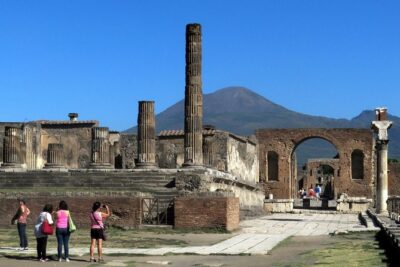
Then you look at the Forum, Pompeii’s main square. This is where you start to understand the city as a living system. Once you grasp what the Forum was, it becomes easier to connect later stops to what people valued and needed.
A key consideration here is pace. Because the tour is about two hours, you will not linger for long. The upside is momentum. You will not end up standing around waiting for your group to catch up. The downside is that you might want more time if you are the type who reads every inscription and studies every corner.
Granai del Foro plaster casts: the most moving stop on the route
One of the tour’s strongest emotional beats is the pause at the Granaries of the Forum (Granai del Foro). This is where you can see victim plaster casts connected to the eruption, and it is also where you notice details like casts of a dog and a tree.
This stop changes your understanding of Pompeii. Without this kind of moment, Pompeii can feel like a museum of architecture. With the casts, the story becomes human and immediate. You see the tragedy as bodies caught in a final instant, not as an abstract “disaster event.”
Even the way the tour is structured supports this. You get the big civic picture first (Basilica and Forum), and then the Granaries step in as the shock. It is a strong storytelling order because it shifts your brain from “what is this place?” to “what happened here?”
If you are sensitive to intense historical imagery, plan your mindset for this moment. It is not a gore-fest, but it is genuinely heavy, and that is part of its power.
A different sort of day around the Bay of Naples:
- From Naples: Pompeii Ruins & Mount Vesuvius Day Tour
★ 4.3 · 11,459 reviews - Naples or Sorrento: Full-Day Pompeii and Mount Vesuvius Tour
★ 4.6 · 4,235 reviews - Pompeii & Mt.Vesuvius Day Tour from Naples with Pizza Lunch
★ 4.0 · 2,901 reviews - From Naples: Pompeii Skip-the-Line Entry Ticket and Tour
★ 4.4 · 2,753 reviews
House of Menander and frescoes and mosaics you might actually spot

After the civic and tragedy anchor, the tour shifts toward private life. The House of Menander is one of the richest homes in Pompeii, and it is known for both architecture and decoration, plus its contents.
What makes this kind of stop valuable is that it helps you move past the idea that Pompeii was just temples and streets. You start seeing how status and wealth showed up in everyday spaces. The guide’s explanation helps you notice patterns that would otherwise blur together.
You also spend time along the main street and pause to admire decoration such as frescoes and mosaics inside key buildings. Pompeii is famous for these details, but when you walk too fast, they turn into background art. Here, you get timing that gives your eyes a chance to actually register what you are looking at.
One reality check: with only two hours total, you are not going to experience every room. You will see highlights, and the guide helps you identify what those highlights are.
Stabian Baths and the Lupanar: Roman leisure and the city’s darker side
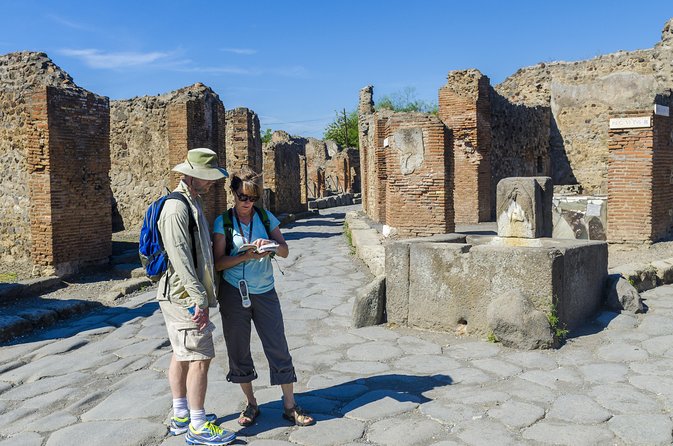
The Stabian Baths (Terme Stabiane) are next, and these thermal baths occupy a vast area. They are also described as representing the oldest thermal complex in the city. That helps you connect a major public space to the development of Pompeii over time.
Bath culture in the Roman world was not a quick wash. It was social life. The guide’s job is to help you picture how people used the baths as meeting places, not just hygiene stops.
Then comes the Lupanar, Pompeii’s most famous brothel ruin. This is the tour’s “difficult” stop for some people, and it is also one of the most historically interesting. It shows you that Pompeii included the same messy realities as any city: commerce, power, and human need.
If you are visiting with kids, you will want to judge the age and your comfort level. The tour requires children to be accompanied by an adult, but the topic is what it is. Some families still find it manageable because the guide keeps it factual and tied to how the site worked.
House of the Faun and the Teatro stops: seeing wealth and public performance
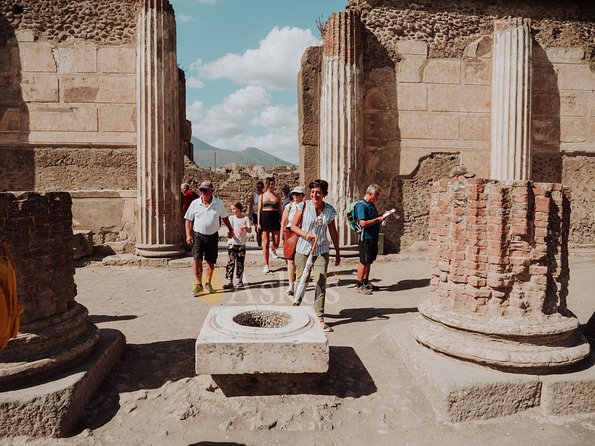
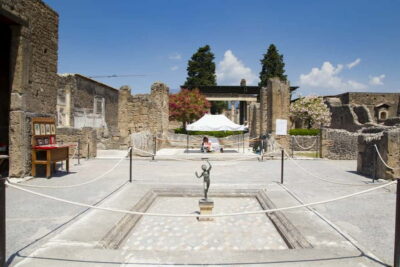
The House of the Faun is one of Pompeii’s largest and most impressive private residences. It reinforces what you learned at Menander: wealth was visible in space, not just in possessions. The guide helps connect architectural scale to how a household lived and hosted.
After the private home section, you get a look at the Teatro Piccolo, then the tour ends with the Teatro Grande. The Teatro Grande is Pompeii’s most important theatre on this route and is the kind of place where you finally feel how public life worked. You can look at the structure and picture crowds assembling for performances.
This ending has a smart effect. It sends you from private rooms to public stages. When the tour finishes inside the ruins, you also feel like you have earned a “last look” at the city’s mood, not just exhausted yourself through it.
Walking conditions and what to bring so the tour feels fun, not exhausting
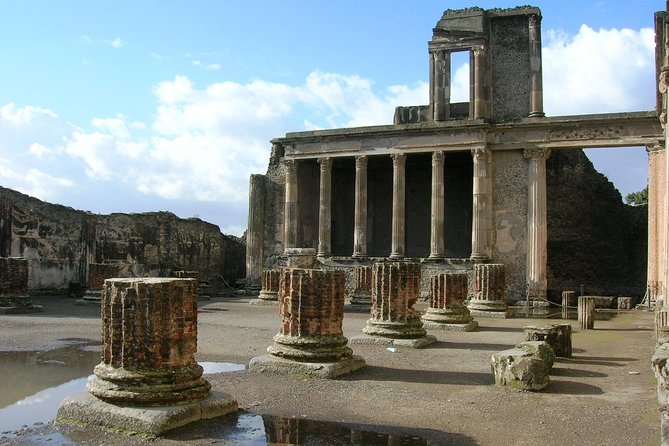
Pompeii is uneven. Expect steps, ramps, and little surprises under your feet. Even if you are in good shape, you will move slower than you think because the ground is not smooth.
For what to bring, the tour info is straightforward:
- Wear comfortable shoes with grip.
- Bring a small bottle of water.
- In summer, use sunglasses and sunscreen.
Shade is limited, and the light can be harsh. A hat can help too, if you have one, because the tour is outdoors and operates year-round in rain or shine.
If you have mobility concerns, note that mobility scooters are not allowed, and the tour is not recommended for travelers with mobility issue or impairments due to steps and ramps. If you fall into that category, the best move is to contact the operator about a more suitable private tour.
Who this tour suits best, and who might prefer a different plan
This is ideal if you want a guided start, then freedom after. The “finish inside the ruins” format works well for people who like to move on after the structured highlights. It is also a good first-Pompeii tour because it hits the big landmarks quickly.
It fits families too, as long as the kids are old enough to handle a couple of hours on uneven stone and a couple of stops that are historically adult in theme. One helpful detail from the tour rules: for under 18 travelers, bring an ID card or passport.
If you like asking questions, this format is built for it. The small-group size and headsets for larger groups mean the guide can keep a conversation going without losing the whole path.
If you are the type who hates guided pacing and wants total freedom, you might feel limited by the stop timing. In that case, consider spending more time self-guided, or booking a shorter add-on route later when you are less pressured by the clock.
Should you book this Pompeii archaeologist small-group tour?
I think you should book if you want Pompeii to make sense fast. This tour is built around the city’s main civic spots, then it adds the places that show how people lived, relaxed, and feared the end. The inclusion of Granai del Foro plaster casts gives the experience emotional weight without turning it into a slow, heavy slog.
Book it if you care about value and orientation. $35.67 for a guided, small-group, archaeology-led route with Pompeii Express entry is a fair deal for a site that otherwise requires serious learning just to interpret what you see.
Skip it or choose a different option if you need full accessibility or if you want to spend the entire day in Pompeii. This tour is about two hours, and it is focused. You will leave with highlights and context, not full coverage.
If you do book, wear your best walking shoes, start hydrated, and go in ready to notice details. Pompeii rewards curiosity, and a good guide helps you earn it.
FAQ
How long is the Pompeii small group tour with an archaeologist?
It runs for approximately 2 hours.
Where does the tour start?
The tour starts at Via Villa dei Misteri, 2, 80045 Pompei NA, Italy. The guide meets you at the Porta Marina Superiore entrance.
What language is the tour offered in?
The tour is offered in English.
Is the entrance ticket included?
Yes. You get a Pompeii Express entrance ticket included with the tour.
Does the tour use skip-the-line entry?
Yes. The tour includes skip-the-line access.
How big is the small group?
The group size is maximum 20 travelers per guide.
Are headsets provided?
Headsets are provided for groups of 16 or more.
What major sites are included during the walk?
You visit stops including the Basilica, the Forum, the Granaries of the Forum (Granai del Foro), the House of Menander, the Stabian Baths, the Lupanar, the House of the Faun, and you also see viewpoints of Teatro Piccolo and go inside Teatro Grande.
What should I wear or bring?
Wear comfortable shoes. Bring sunscreen and sunglasses in summer, and bring a small bottle of water.
Is food or transportation included?
No. Food and drinks are not included, and transportation is not included.
Recently reviewed around Pompeii
- Pompeii Audioguide – TravelMate app for your smartphone★ 3.9 · 10 reviews
- Pompeii: Entrance Ticket – Skip the Line★ 3.8 · 64 reviews
- Pompeii: Entry Ticket & Guided Tour with an Expert Historian★ 5.0 · 4 reviews
- Pompeii: AR Glasses Augmented Reality Tour★ 5.0 · 3 reviews
- Pompeii Small Group Tour – Tickets Included★ 4.7 · 72 reviews
- Pompeii: Skip-the-Line Ticket and Virtual Museum★ 4.5 · 66 reviews
- From Naples: Pompeii & Mount Vesuvius Full-Day Private Tour★ 4.5 · 4 reviews
- Pompeii with Wine Tasting Private Tour★ 4.7 · 6 reviews
Pompeii Tours, compared.
Entry Ticket and Guided Tour with an Archaeologist
Read our review →

Naples or Sorrento: Full-Day Pompeii and Mount Vesuvius Tour
Read our review →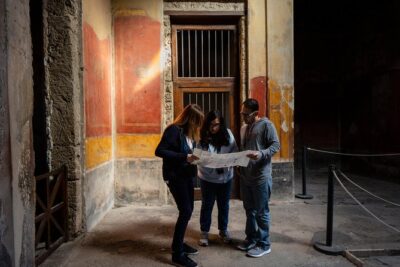
Pompeii & Mt.Vesuvius Day Tour from Naples with Pizza Lunch
Read our review →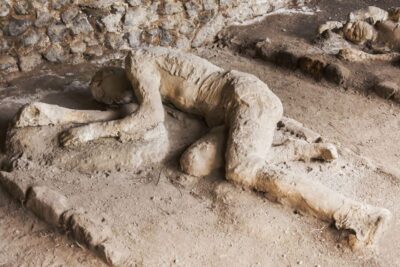
Pompeii & Mt Vesuvius All-Inclusive Small Group w/ Lunch
Read our review →Browse the lists this tour appears in