
Reviewed · POMPEII TOURS
Pompeii 3 Hours Walking Tour Led by an Archaeologist
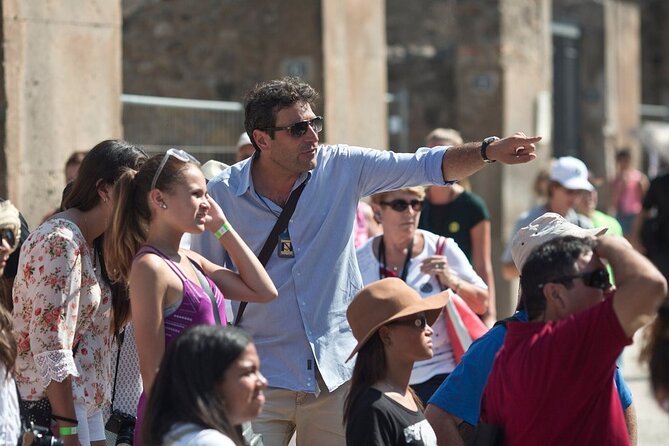
Pompeii is already dramatic, but this archaeologist-led private walking tour makes it feel readable. In about three hours, you walk through the city’s key public places and the homes people actually lived in, right up to the details that explain what happened when Vesuvius erupted.
What I like most is how easy the route feels to follow and how the stop order keeps the story straight. You start at the Porta Marina Superiore entrance, then move through the Basilica, the Forum area, baths, houses, and theaters without that wandering, guess-what-this-is energy. You’ll also often get a very human guide style, with scholars such as Monica (PhD in archeology) or art historian Daniela Mantice showing up in past departures.
One consideration: Pompeii is exposed with minimal shade, and the tour takes place rain or shine. Bring sunscreen and a hat, and plan your energy, because this is a walking experience across a large site.
Key Things You’ll Notice on This Pompeii 3-Hour Walk
- Private pacing that actually works on a big site: you get 3 hours with only your group, so your guide can slow down for questions.
- Admission coverage where it counts: Pompeii entry is included for the first stop, and the Granaries stop also includes tickets.
- Roman daily life, not just ruins: you see bath complexes, marketplaces, theaters, and neighborhood buildings that explain how people spent their days.
- Real architectural and decorative detail: highlights include the House of Menander and the House of the Faun, both known for standout decoration and layout.
- Thermal baths and everyday tech: Stabian Baths show the oldest thermal complex in the city, and the route is designed to make sense of it.
- A guided look at the city’s edges and extremes: the Lupanar is part of the route, so you understand Pompeii’s social world, not only its “pretty” parts.
Pompeii in a Tight Time Window, With an Archaeologist in Control
The biggest advantage of a 3-hour Pompeii tour is focus. Pompeii is large, and if you go in solo you can spend most of your time asking, What is this? Where does it fit? This tour is structured so you get a guided storyline, from public life to private spaces, in a time window that won’t hijack your entire day.
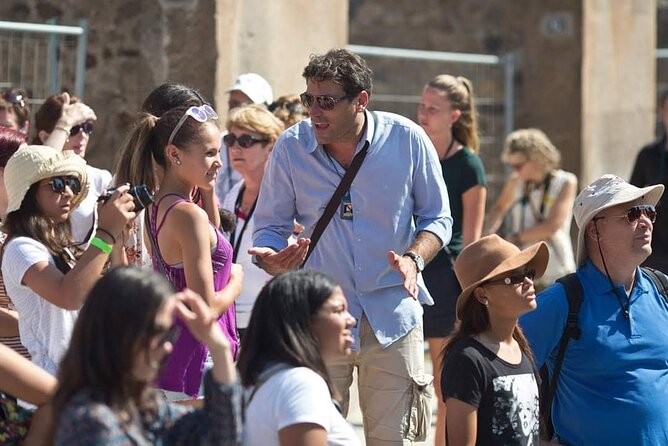
I also like the tone implied by the guide setup. The tour is led by a professional archaeologist guide, and you can expect both historical context and technical interpretation. Past guides have included people with specialist backgrounds, like art historian Daniela Mantice, who shared science-minded explanations about how Vesuvius-related events interacted with painted surfaces. That kind of detail is exactly what turns buildings from scenery into evidence.
The route is not trying to hit everything. It hits the right kinds of places: a civic shelter space (Basilica), a main square (Foro), storage and household-linked water features (Granaries area), bath infrastructure (Stabian Baths), houses with art and status (Menander and Faun), a notorious neighborhood building (Lupanar), and both smaller and larger performance spaces (Odeon and Teatro Grande).
More Pompeii tours and tickets in Pompeii:
- Pompeii: Entry Ticket and Guided Tour with an Archaeologist
★ 4.8 · 19,459 reviews - Pompeii: Entry Ticket with Optional Audio Guide
★ 4.2 · 12,360 reviews - Pompeii: Small Group Tour with an Archaeologist
★ 4.8 · 12,264 reviews
Price and Value: What You’re Really Paying For
At $256.99 per person for an approx 3-hour private walk, this is not a budget tour. But the value case is pretty solid if you care about interpretation, not just photos.
Here’s where your money goes:
- You’re paying for a professional archaeologist guide, which changes how you experience the site.
- Admission fees are included for Pompeii entry at the start, and at the Granaries of the Forum stop.
- You’re not sharing the walk with strangers. Private means your guide can tailor pacing and answer questions without time getting eaten by a large group.
Also, the tour is customizable as a private experience. That matters in Pompeii, because your personal interests will pull you toward different corners, and you don’t want your afternoon controlled by a rigid group schedule.
One practical note: it’s commonly booked about 50 days in advance on average. If Pompeii is a key part of your trip, I’d treat this as something to lock in earlier rather than hoping you can fit it last minute.
Meeting Point at Via Villa dei Misteri, and How the Tour Gets You Started Smoothly
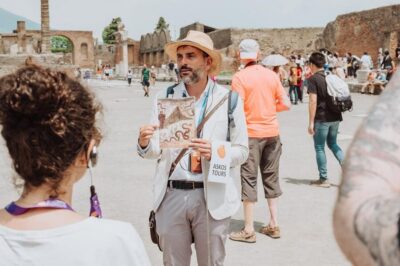
The tour meets at Via Villa dei Misteri, 1, 80045 Pompei NA, Italy, and it starts and ends at that same address. The guide is meeting you at the main entrance of the archaeological park called Porta Marina Superiore, holding a sign with the company name Askos Tours.
This is more than a small detail. A lot of frustration on site tours comes from hunting down a guide in a crowded entrance area. Here, you get a clear meeting reference point plus an obvious signage cue.
Two other “make it easier” items are baked in:
- There’s a free luggage store at the meeting place, so you can travel lighter during the walk.
- The tour runs rain or shine, so you’re not left guessing if your day will get delayed.
The 1st Stop at Porta Marina Superiore: Entry, Orientation, and First Clues
Your first stop is Pompeii Archaeological Park at Porta Marina Superiore. Admission is included here, so you don’t have to do the awkward stop-and-start of getting tickets figured out while everyone’s already mid-walk.
In the first minutes, a good archaeologist guide does two things. They get you oriented, and they set the “how to read Pompeii” lens. With this tour, that lens is Roman life before the eruption of Vesuvius, which is why the route later keeps moving between civic spaces, domestic spaces, and utility spaces.
Even if you’ve seen Pompeii photos before, starting with a clear orientation helps you understand scale and function. The city is not just pretty facades. It’s an operating system: roads, public shelter, water and bathing, work and trade, and homes arranged by status and taste.
More walking tours in Pompeii:
- Pompeii: Guided Walking Tour with Entrance Ticket
★ 4.3 · 1,423 reviews - Discover Pompeii: French Walking Tour of the Buried City
★ 4.8 · 253 reviews - Pompeii: Highlights Guided Walking Tour
★ 4.6 · 105 reviews - Pompeii: 3D Walking Tour with Entry Ticket
★ 4.3 · 102 reviews
Basilica: The Open Portico Where Merchants Did Business
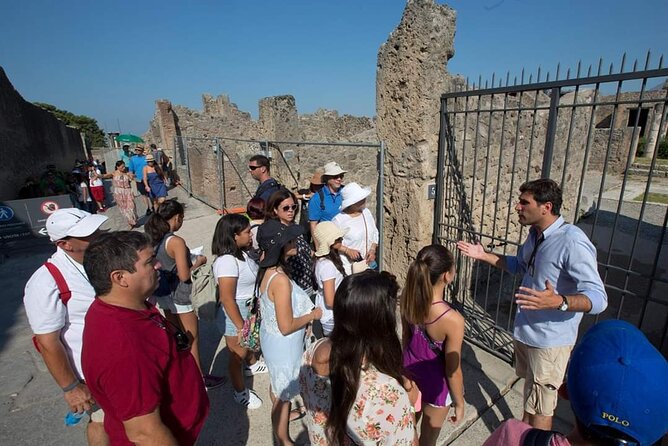
The Basilica stop is designed as an early anchor to Pompeii’s public rhythm. This building is described as an open portico that gave shelter to merchants and other activities.
What’s useful here is the “so this is why it looks like that” angle. When you see the portico as a working shelter space, it stops feeling like abstract architecture. You start picturing real human movement, trade conversations, and the daily flow of people using shade and cover when the weather demanded it.
The Basilica stop is about 20 minutes and admission is free for this stop, which makes it a straightforward, high-yield early chapter. It’s also a great place to ask your first big questions about how Romans organized public space, since your guide can connect this scene to the Forum square you see next.
Foro de Pompeya: Pompeii’s Main Square, Read Like a City Center
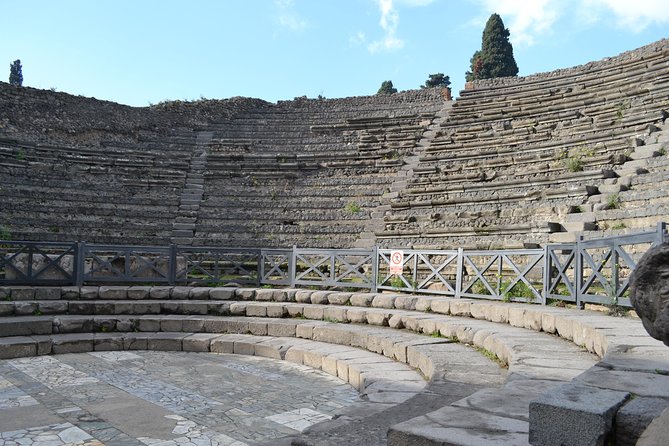
Next comes the Foro de Pompeya, the ancient main square of Pompeii. It’s a 20-minute stop, also free to enter.
In practical terms, the main square is where you learn what mattered. A city center is where messages move, commerce happens, and identity gets performed. When you stand in the Forum area with a guide, you’re not just looking at stones. You’re learning how civic life worked.
This is also where the walking tour style helps. If you’re moving from the Basilica to the Forum area, you naturally shift from a shelter for commerce to the open civic stage where that commerce likely fed into broader public activity. It’s a clean mental transition that you’d struggle to recreate if you only arrived and wandered.
Main Street Walk: Why the Route Between Stops Matters
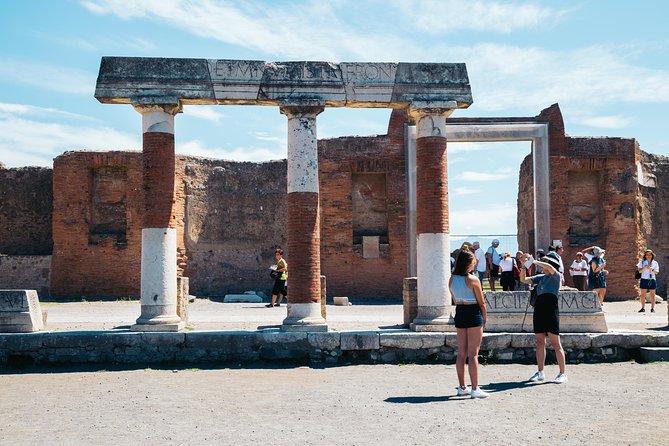
After the Forum area, the tour takes you along the main street of Pompeii. This part is brief in the schedule, but it’s important for how you experience the site.
Walking the main street is how you connect the dots between the big public areas. It helps you feel the city as a network instead of isolated highlights. For me, this kind of “in-between” walking is where interpretation sticks, because your guide can point out the logic of spacing and the way people likely moved from one daily activity to the next.
If you’re the type who likes to understand how a place functions, you’ll feel a lot more grounded after this street segment than after a purely stop-heavy tour.
Granaries of the Forum: Marble Tables, Water Features, and Casts of the Eruption
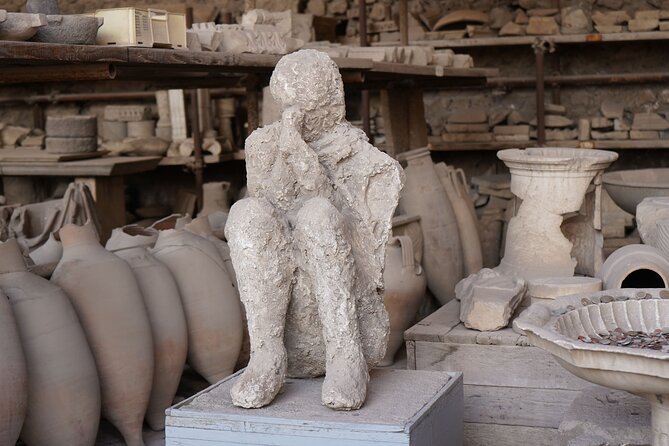
This stop is one of the most powerful on the list. It includes the Granaries of the Forum, and admission is included.
Here’s what you’ll see, in the tour description:
- Marble tables
- Baths for fountains that adorned entrances of houses
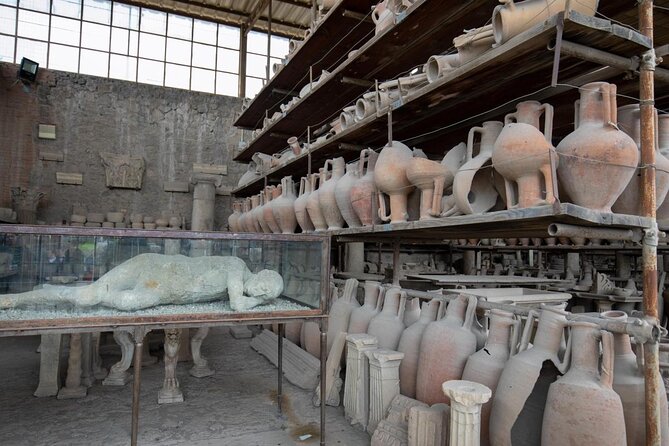
- Casts of victims of the eruption
- Casts that include a dog and a tree
That mix of elements is the point. You get household-linked water design through the fountain bath description, and you also get the human reality of the eruption through the casts. The dog and the tree detail is also a reminder that Pompeii’s tragedy involved more than just buildings.
Two things I find valuable at stops like this:
- The guide can help you connect “utility” objects to everyday life. Marble tables and fountain-adjacent features tell you what neighbors likely saw and used.
- The guide can contextualize the casts so you don’t just see them as shocking artifacts, but as evidence of how the eruption affected a whole living community.
You spend about 20 minutes here, which is usually enough time to see the key items and still keep the tone moving forward without getting stuck.
House of Menander: Status, Architecture, and Decorative Choice
Then you step into the House of Menander, one of Pompeii’s richest and most magnificent houses in terms of architecture, decoration, and contents. This stop is about 20 minutes and free.
Houses are where Pompeii becomes personal. When the guide points out architecture and decoration, you start understanding how wealth showed up in daily layout and aesthetic choices. Rich houses weren’t just bigger. They were curated experiences, with rooms that communicated taste, status, and sometimes political or cultural identity.
If you’re interested in design, art, or how people signaled social rank in the ancient world, this is one of the best stops on the route. It’s also a good contrast point after civic life in the Forum area, because you’ll feel the shift from shared public spaces to private household culture.
Stabian Baths (Terme Stabiane): The Oldest Thermal Complex You Can Visit
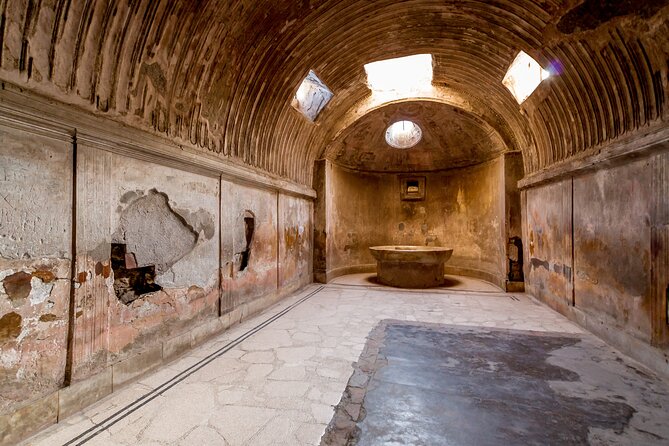
The Stabian Baths stop takes you to the oldest thermal complex in the city, and it’s set in a vast area between key crossroads and the Via Stabiana. The tour gives it about 25 minutes, and it’s free to enter.
Even if you’re not a “bath person,” a thermal complex is a window into infrastructure and community habits. Baths are where Romans handled hygiene, social time, and sometimes business. The sheer size of the Stabian Baths area also helps you grasp that bathing was not a quick private routine. It was a big civic activity.
This stop also tends to benefit from an archaeologist guide because you want the “how did it work” explanation, not just where to stand to see what’s left. You learn how the space was organized and why it mattered to daily life.
Lupanar: The Famous Brothel and Pompeii’s Social Side
The Lupanar is the most famous brothel in Pompeii. It’s about 20 minutes and free, and it’s an important inclusion for anyone who wants Pompeii to feel honest, not sanitized.
The tour framing helps here. By placing the Lupanar after baths and before the theaters, the route covers different sides of social life: public leisure, then a more morally charged and sensational private commerce space. The guide can keep it factual and grounded, so you understand the setting without reducing it to cheap shock value.
If you are sensitive to sexual content or explicit themes, this is the moment to decide how you want the visit handled. The good news is that the stop is time-bounded in a 3-hour route, and your guide can keep the discussion focused on historical and architectural context.
House of the Faun: A Large Private Residence With Big Presence
Next comes the House of the Faun, described as one of Pompeii’s largest and most impressive private residences. About 20 minutes, and free to enter.
This house is a contrast to Menander. If Menander shows wealth through decoration and an impressive package of rooms, Faun often leaves you with a sense of scale and command. You walk through a property that feels like it was designed to impress both insiders and visitors.
I like this stop because it helps you understand what “a rich home” means in Pompeii: not just status, but how a residence shaped movement and view lines, and how private life was built around spaces meant to be seen and used.
Odeon and Teatro Piccolo: Performance Spaces in Smaller Form
The Odeon, also referred to as Teatro Piccolo, is a short stop of about 5 minutes and free.
Even with limited time, a guide can make this quick section count. A small performance venue like this helps you expand Pompeii beyond houses and everyday utilities. It signals that entertainment and public gathering were woven into the city fabric, not saved for special occasions only.
Teatro Grande: Pompeii’s Major Theater With Big-Stage Energy
The tour ends with Teatro Grande, Pompeii’s most important theater. This is about 20 minutes and free.
This is the big finale for a reason. After seeing markets, baths, homes, and the Lupanar, the theater brings it all together: public assembly, performance culture, and the architectural confidence to host crowds.
If you’re trying to remember Pompeii as a full society, Teatro Grande often becomes the visual memory anchor. It’s easier to picture the sound, the crowd, and the energy because the space is meant for that. With a guide, you also get context on why it mattered and how it functioned as part of civic life.
Group Size, Customization, and Why This Feels Different Than a Mega Tour
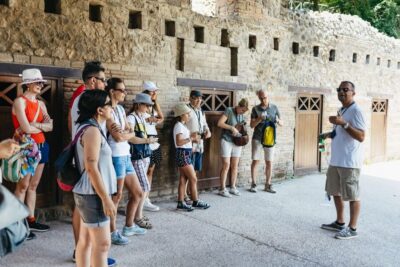
This is a private tour. Only your group participates. That one line changes everything in Pompeii, where distances and fatigue can derail your attention.
Customization matters too. Even if the route has set stops, private pacing means you can request a little more time at a favorite place or ask a focused question mid-walk.
The guide also has room to adapt based on how the group is doing, and you’ll feel that during the 3 hours. In a mega-group format, you often lose half your time to queue movement. Here, the schedule is designed to keep you moving with purpose.
What to Bring and How to Plan Your Pompeii Day
Because the site is vast and exposed with minimal shade, the tour specifically recommends sunscreen and a hat. That’s not optional advice here. Pompeii can feel like a sun trap even on days that look comfortable at first.
The tour runs rain or shine, so if your trip has weather swings, plan for that reality. The upside is that you’re not stuck waiting for a reroute unless conditions get truly unsafe, and the guide aims to keep the day on track.
If you’re bringing children, they must be accompanied by an adult. The tour also notes that most travelers can participate, which is helpful if you’re deciding whether a walking-focused route works for your group.
Should You Book This Pompeii Archaeologist Tour?
If you want Pompeii to make sense, not just impress you, I think this is a strong pick. The combination of a professional archaeologist guide, a tight 3-hour plan, and admission coverage at key points makes it a practical choice for a first-time visit.
I’d book it if:
- You want a structured walk through public life, domestic spaces, baths, and theaters.
- You like asking questions and getting explanations tied to what you’re seeing in the moment.
- You prefer private pacing over managing a large-group shuffle.
I might skip it if:
- You’re planning to spend most of the day wandering slowly on your own and you don’t want admission included only for certain stops.
- You expect mostly shade and low walking, since Pompeii is exposed and this is a walking tour.
Overall, for a 3-hour slot in Pompeii, this tour gives you a clean, focused way to read the city like a living place that was interrupted, then preserved. If that is your goal, you’ll feel well taken care of by the time you reach Teatro Grande.
Recently reviewed around Pompeii
- Pompeii Audioguide – TravelMate app for your smartphone★ 3.9 · 10 reviews
- Pompeii: AR Glasses Augmented Reality Tour★ 5.0 · 3 reviews
- Pompeii: Entrance Ticket – Skip the Line★ 3.8 · 64 reviews
- Pompeii: Entry Ticket & Guided Tour with an Expert Historian★ 5.0 · 4 reviews
- Pompeii Small Group Tour – Tickets Included★ 4.7 · 72 reviews
- Pompeii: Skip-the-Line Ticket and Virtual Museum★ 4.5 · 66 reviews
- From Naples: Pompeii & Mount Vesuvius Full-Day Private Tour★ 4.5 · 4 reviews
- Pompeii with Wine Tasting Private Tour★ 4.7 · 6 reviews
Pompeii Tours, compared.
Entry Ticket and Guided Tour with an Archaeologist
Read our review →

Pompeii Small Group Tour with an Archaeologist
Read our review →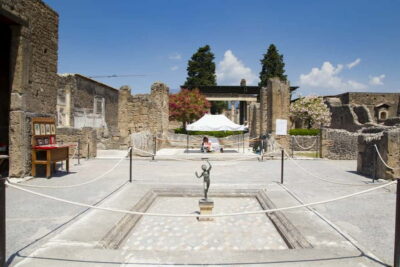
Naples or Sorrento: Full-Day Pompeii and Mount Vesuvius Tour
Read our review →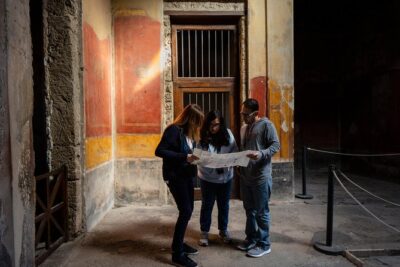
Pompeii & Mt.Vesuvius Day Tour from Naples with Pizza Lunch
Read our review →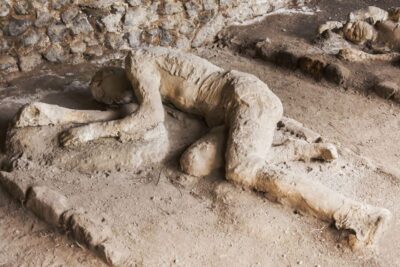
Browse the lists this tour appears in