
Reviewed · POMPEII TOURS
Ancient Pompeii Private Tour: Skip the Line & Kid-Friendly Option
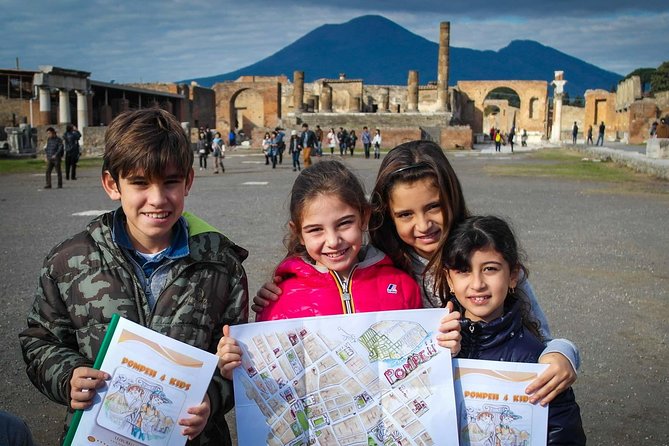
Pompeii is the kind of place that can feel overwhelming fast, but this private skip-the-line plan gives you structure and momentum. I like that you get an actual guided walk through the city highlights, not just a list of ruins, and I especially like the kid-focused option with Pompeii4kids games, stickers, and a special map. One drawback to consider: you are walking, so if you or your group has mobility limits, you will want to set expectations with your guide early.
This is a 2-hour, private, English-language outing built around Pompeii’s big must-sees. I’d treat it as a high-value way to get the stories behind what you’re seeing, from the Forum and baths to the casts of the victims, without losing hours to ticket lines. On hot days, pacing matters, so plan for sun and water, and if you have flexibility, aim earlier in the day.
Key things I’d zero in on
- Skip-the-line timing to keep your limited hours from melting away in queues
- Kid-friendly Pompeii4kids option for ages 6 to 11, with map, stickers, and activities
- A private guide who can tailor the route when you want specific stops
- The Forum and Via dell’Abbondanza to understand how Romans moved through work, worship, and commerce
- Terme del Foro (Forum Baths) for a clear, step-by-step view of Roman bathing
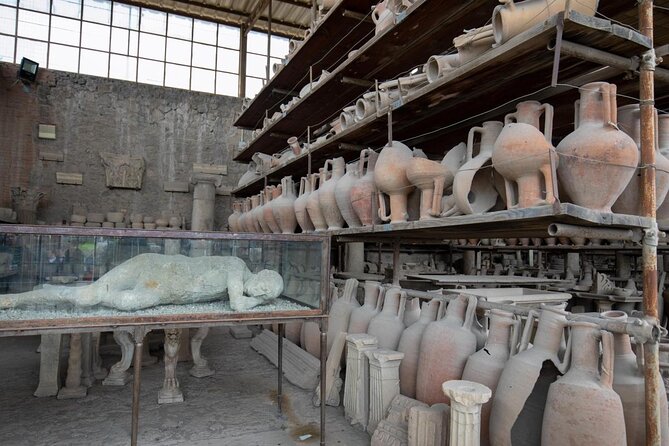
- Antiquarium casts for a sober, unforgettable look at what the eruption preserved
Why skip-the-line and a private guide matters in Pompeii
Pompeii is large, uneven, and popular. If you try to wing it, you lose time twice, once to lines and again to uncertainty about what you’re looking at. With a private guide plus skip-the-line entry, you keep the day moving and you spend your energy where it counts, on understanding the places you’re standing in.
You also get something underrated in ruins: a human pace. A guide can stop when the light is right for photos, spend extra time where your family shows real interest, and shorten the parts that do not land with your group. Several guides have been praised for engaging kids and keeping adults interested too, so you’re not stuck choosing between a tour that is fun for children and one that is meaningful for grownups.
More Pompeii tours and tickets in Pompeii:
- Pompeii: Entry Ticket and Guided Tour with an Archaeologist
★ 4.8 · 19,459 reviews - Pompeii: Entry Ticket with Optional Audio Guide
★ 4.2 · 12,360 reviews - Pompeii: Small Group Tour with an Archaeologist
★ 4.8 · 12,264 reviews
Price and what you really get for $165.05 per person
At $165.05 per person for about 2 hours, this is not the cheapest way to see Pompeii. But the value here comes from the combination: private guide time, skip-the-line access, and a route that targets the city’s major highlights.
There is one practical wrinkle worth noting from the details you’re given: the tour information says admission fee is included, but it also says admission fees are not included and the guide can buy tickets quickly on the spot. That is something you should confirm in your booking. Either way, the intent is clear: you should not be stuck managing ticket chaos, your guide should help you get through quickly.
The family option for ages 6 to 11: Pompeii4kids in real life
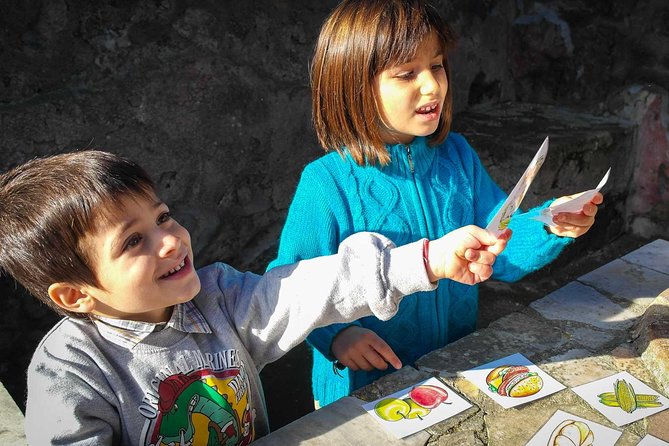
If you’re traveling with children, the family option is one of the strongest reasons to choose this tour. It’s designed for kids ages 6 to 11 and comes with a Pompeii4kids kit that includes a map, stickers, activities, and an activity-book. The idea is simple: kids learn by doing, not just by listening.
In practice, that means your guide uses games and clues tied to what you’re seeing, then has children use stickers on the map as they explore. Multiple families have highlighted how this kind of structure turns Pompeii from scary piles of stone into a game board where they can place characters like gladiators, actors, slaves, and politicians on the buildings tied to their lives.
Even better, you still cover the core Pompeii highlights, so you do not lose the adults’ experience while the kids are entertained.
Your guided walk through Pompeii’s best-known spaces (2 hours)
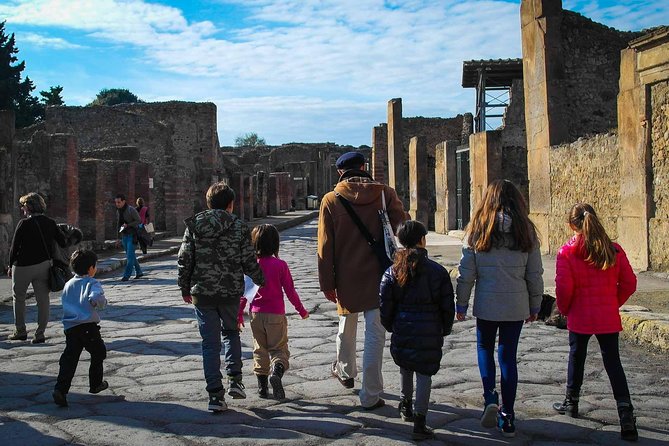
This tour is a focused loop through Pompeii’s top areas. You meet at Via Villa dei Misteri, 2, 80045 Pompei NA, Italy, then the tour ends back at the same meeting point. That round-trip matters because you are not spending half your day relocating.
Also, Pompeii is hot in summer and shady spots are not guaranteed. People have specifically noted clever routing that helps with breezes down the main areas, but you should still bring sun protection and water planning.
A few more Pompeii trips worth comparing
- From Naples: Pompeii Skip-the-Line Entry Ticket and Tour
★ 4.4 · 2,753 reviews - Pompeii: Skip-the-Line Entrance Ticket with Audio Guide
★ 4.0 · 2,509 reviews - Pompeii: Skip-the-Line Entry Ticket with Audio Guide or Tour
★ 4.1 · 1,364 reviews - From Naples: Pompeii Guided Tour with Skip-the-Line Tickets
★ 4.8 · 1,171 reviews
Stop 1: Archaeological Park of Pompeii (start here, get oriented)
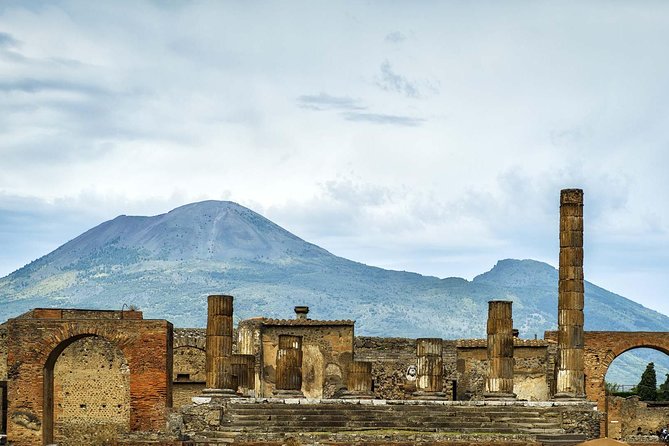
Your guide begins by framing Pompeii and the eruption of Mount Vesuvius in AD 79, when ash and molten material preserved the city. From the start, you should expect the guide to connect ruins to daily life, including what Romans did in public spaces and what the layout tells you about the culture.
This stop is where you also get your first wave of photo opportunities, especially for recognizable features like wall paintings and floor mosaics you can see in restored or preserved areas. If you’re doing the family option, this is often when the kit gets used first, so kids can settle in fast.
Stop 2: Forum of Pompeii (the political and religious center)
Next comes the Forum, a rectangular pedestrian plaza (about 157 by 38 meters) that was off-limits to chariot traffic. For first-timers, this is one of the most important stops because it shows you how the city organized power, belief, and business in one central area.
The guide’s job here is to translate stone architecture into civic function. You’ll learn what the Forum was used for and how it worked as Pompeii’s heart. In a private format, you can ask questions and get a straight answer instead of trying to keep up in a large crowd.
Stop 3: Via dell’Abbondanza (Pompeii’s main street)
Then you move to Via dell’Abbondanza, the longest and most important street, serving as the Decumanus Inferior, stretching from the Forum toward the Sarno Gate. This is your daily-life corridor. The buildings lining this street give you a vivid sense of how people moved between political center, markets, and neighborhood life.
A practical perk here is visual continuity. Once you understand the street’s role, other ruins around you stop feeling random. You start seeing Pompeii like a city, not like a museum exhibit.
Stop 4: Terme del Foro (Forum Baths, step-by-step bathing)
At Terme del Foro, you get one of Pompeii’s most satisfying lessons in routine: Roman bathing. These public baths were built around 80 BC and were still in operation when Vesuvius erupted in 79 AD.
Your walk through this complex follows a sequence:
- Apodyterium, the changing room
- Frigidarium, cold bath
- Tepidarium, warm room
- Calidarium, hot room
You’ll also see high barrel-vaulted ceilings with stucco reliefs and terracotta figures called telamones. This stop works for almost everyone because it is tangible. When you can picture the order of spaces, Roman daily life stops being abstract.
Stop 5: Temple of Apollo (an anchor landmark)
The Temple of Apollo sits in the Forum area and dates back to the 6th century BC. This is one of the oldest major religious sites you’ll see in Pompeii, and it acts like a landmark for the whole tour.
The temple blends Greek and Italic styles, with an elevated podium reached by stairs and a portico with 48 columns. You may also see bronze replica figures of Apollo as an archer and his twin sister Diana, while the originals live in the National Archaeological Museum in Naples.
If you want a feel for how religion shaped public spaces, this is a key pause.
Stop 6: Basilica (big public building power move)
In the Forum area, the Basilica is the major public building in the southwestern corner. It dates to the 2nd century BC and is one of the oldest of its kind in the Roman world.
In a private tour, the guide can explain what basilicas did for civic life, so the building does not become just another large ruin. It’s worth slowing down here if the guide offers architectural details, because it helps you read what you’re seeing later.
Stop 7: Casa dei Vettii (the opulent “Sistine Chapel” of Pompeii)
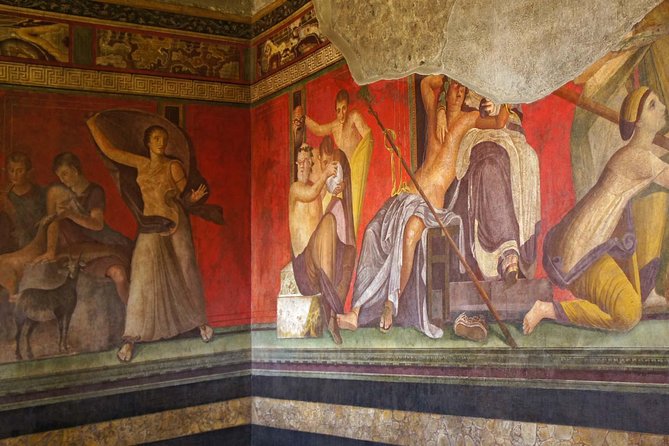
Then you enter residential luxury with Casa dei Vettii. This house is often compared to a masterpiece of frescoes and preservation, and it was reopened in 2023 after a long restoration.
This home belonged to two freedmen turned wealthy wine merchants. The point of the house is status. You can see how the owners used art and design to show their new position.
Families often like this stop because it is visual and story-driven. Adults like it because it connects wealth and social change to real architecture and decoration.
Stop 8: Teatro Grande (Greek to Roman in stone)
The Teatro Grande is a masonry theater carved into a lava hillside, built in the 2nd century BC. The value here is the transition from Greek to Roman architectural styles. It’s a reminder that Pompeii was not a one-time snapshot, it evolved.
If your group enjoys design, this is a good one to linger in, even if the stop time is shorter, because theaters are easier to understand once you picture where the audience sat and where performances happened.
Stop 9: Antiquarium di Pompei (casts of the victims)
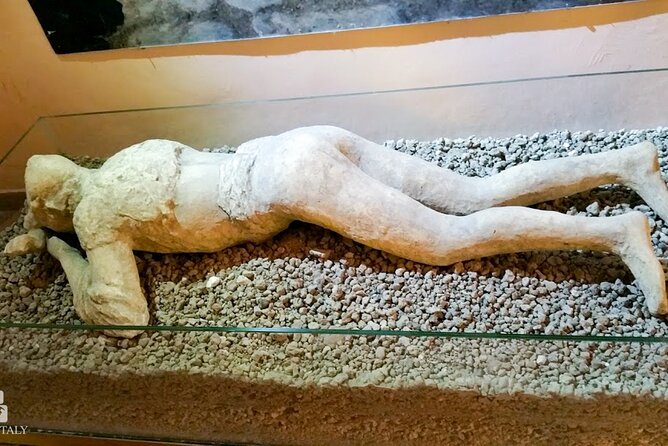
Finally, you step into the Antiquarium museum area, which is climate-controlled and designed to protect fragile artifacts. This stop includes the famous casts of victims preserved in the eruption’s aftermath.
Some casts remain in situ in the ruins, but the museum displays several plaster casts, including children preserved in their final moments. This part of Pompeii is emotionally heavy. A good guide handles it with care and keeps it human, not sensational.
Even if you are unsure how you will handle it, plan for this stop. It’s one of the most unforgettable pieces of Pompeii, and it adds weight to everything you saw earlier.
Guide style is the difference between a good and great Pompeii day
A big theme in the best experiences is guide performance. People have praised guides for being engaging, patient with kids, and able to answer questions on the spot. Names that come up strongly include Francesca, Anna, Viviana, Sabrina, Giuseppe, Alfredo, Natalia, and Nandor, plus Fabrizio showing up repeatedly in responses.
What I’d take from those highlights, and what you can use to choose smartly, is this: ask your guide how they plan to manage your group’s pace. If you have very young kids, mention it. If you have older kids who want detail, mention that too. A private format is only private in the technical sense unless the guide actively tailors the day.
One caution: there was at least one experience where the guide rushed the pace, and another situation where mobility issues made keeping up harder. That is not inevitable, but it is a reminder. In your first minute, say what you need, and ask the guide to slow down if necessary.
Timing tips: beat the heat and get better photos
Pompeii can get brutally hot. A family noted that they went at 11am and by the end it was really hot, then suggested that booking earlier, around 9:30, would be better next time.
So here is your practical move: if you can choose timing, earlier in the morning is your friend. Also wear breathable clothing and bring water. You can plan the day to be shorter and calmer by leaning on the guide’s route knowledge instead of wandering.
What to bring, since this is a walking tour
The tour calls for moderate physical fitness and recommends good walking shoes. You should plan for a walking-heavy experience on uneven ancient terrain.
I’d also bring:
- Sun protection (hat or cap, sunscreen)
- A water bottle you can keep accessible
- A phone or small device for photos, plus any ticket info you receive
If you are using a mobile ticket, one guide helped solve an issue when entry tickets did not show correctly on a phone. The takeaway is simple: have a backup method for ticket access, like a screenshot, and expect your guide to help when you hit a snag.
Should you book this Pompeii private tour?
Book it if you want a guided, time-efficient Pompeii experience and you care about getting context, not just photos. It’s especially worth it with kids, because the Pompeii4kids kit turns the ruins into an active learning game for ages 6 to 11. The private format also shines if your group has specific interests, like baths, politics in the Forum, or the casts in the museum.
Skip it or reconsider if your group’s mobility is limited and you cannot keep a walking pace, or if you prefer a self-paced wander where you never stop for explanations. In that case, you can still do Pompeii, but you should be clear with the guide about pacing from the start.
FAQ
How long is the Ancient Pompeii private tour?
The duration is about 2 hours.
Where does the tour start and end?
It starts at Via Villa dei Misteri, 2, 80045 Pompei NA, Italy and ends back at the same meeting point.
What language is the tour offered in?
The tour is offered in English.
Is this tour kid-friendly?
Yes. There is a family option for children ages 6 to 11, with a kid-friendly map, stickers, games, and clues.
Does the tour include skip-the-line access?
Yes. The tour highlights include skip-the-line tickets.
Are admission fees included?
The details provided include admission fee in the included section, but another part of the information says admission fees are not included and the guides can buy tickets quickly on the spot. Confirm what is included for your exact booking before you go.
Is pickup or drop-off included?
No. Pick up and drop off are not included.
What should I prepare for in terms of walking?
The tour is listed as requiring moderate physical fitness, with good walking shoes recommended.
Do children need a passport?
A current valid passport is required on the day of travel for children under 18 years.
How to read the small print, fast
Free cancellation is offered if you cancel up to 24 hours in advance for a full refund. This experience is private, meaning only your group participates.
Recently reviewed around Pompeii
- Pompeii Audioguide – TravelMate app for your smartphone★ 3.9 · 10 reviews
- Pompeii: AR Glasses Augmented Reality Tour★ 5.0 · 3 reviews
- Pompeii: Entrance Ticket – Skip the Line★ 3.8 · 64 reviews
- Pompeii: Entry Ticket & Guided Tour with an Expert Historian★ 5.0 · 4 reviews
- Pompeii: Skip-the-Line Ticket and Virtual Museum★ 4.5 · 66 reviews
- Pompeii Small Group Tour – Tickets Included★ 4.7 · 72 reviews
- From Naples: Pompeii & Mount Vesuvius Full-Day Private Tour★ 4.5 · 4 reviews
- Pompeii with Wine Tasting Private Tour★ 4.7 · 6 reviews
Pompeii Tours, compared.
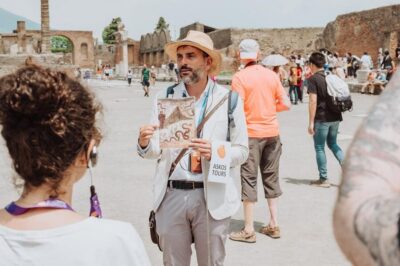
Entry Ticket and Guided Tour with an Archaeologist
Read our review →

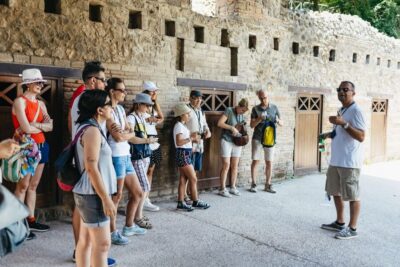
Pompeii Small Group Tour with an Archaeologist
Read our review →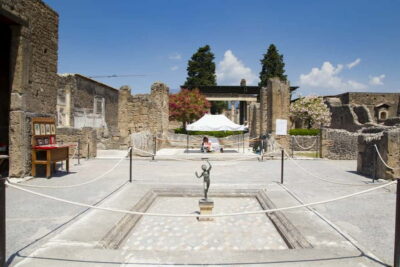
Naples or Sorrento: Full-Day Pompeii and Mount Vesuvius Tour
Read our review →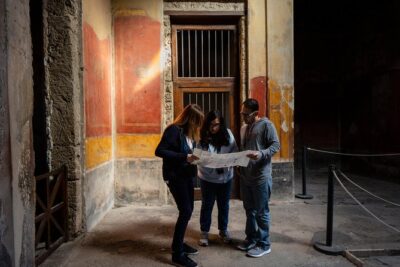
Pompeii & Mt.Vesuvius Day Tour from Naples with Pizza Lunch
Read our review →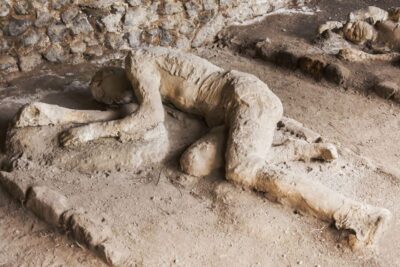
Browse the lists this tour appears in