
Reviewed · POMPEII TOURS
Pompeii 2-hour Private Tour with an Archaeologist-Ticket included
Pompeii is one of those places where your brain wants details fast, but your feet want breathing room. This 2-hour private tour with an archaeologist-tickets included setup is interesting because it swaps the big-group sprint for a guided, stop-focused walk that you can actually follow. I especially like that you start with the official entry and then move through key areas without wasting time guessing what you are looking at. I also like that the guides here tend to bring the site to life with real excavation context, with standouts like PhD archaeologists Silvia and Alessandra, plus guides such as Amedeo and Giovanni who are praised for passion and patience.
One possible consideration: two hours moves quickly. Pompeii has steep, uneven ground and a lot of visual noise, so if you want ultra-slow wandering or long breaks, this format may feel a bit tight. Still, the tour is designed for a smart overview at an easier pace than you get with large groups.
Key highlights that matter before you book
- Private pace, not a rushed herd: only your group participates, so your guide can slow down when needed.
- Ticket included for Pompeii entry: you start with admission covered at the main entrance meeting point.
- Archaeologist-led explanations: multiple guides are praised for turning ruins into lived-in stories with excavation-level insight.
- Forum, baths, and brothel in one route: you see the public core and daily-life zones without spending half the day traveling between areas.
- Stop control works for photos and questions: guides like Mena and Luca are specifically praised for staying focused on what you want to see.
- At the end, you get help finding your way: the guide remains useful for getting back to your accommodation or the nearest train station.
Why this Pompeii tour feels better than a fast group circuit
Pompeii can be overwhelming on your own. The streets are narrow, the views are broken up by walls and scaffolding, and you can end up spending energy just figuring out where you are. This tour is built to prevent that: you meet at a clear place, then you follow a guided route through major landmarks.
The “private” part is not a gimmick. With only your group, your guide can answer questions in real time. You do not have to shout over 30 other people, and you do not have to wait for someone in a different pace to catch up. In the feedback, guides like Ivan, Luca, and Diego are repeatedly credited with making the site click, and the best part is you get that without losing momentum.
For me, the biggest value is how the tour balances structure and flexibility. The itinerary gives you a logical spine through the ruins, but it also allows you to linger when something connects with you. That matters in Pompeii, where the difference between seeing a wall and understanding a wall can be 30 seconds with the right explanation.
More Pompeii tours and tickets in Pompeii:
- Pompeii: Entry Ticket and Guided Tour with an Archaeologist
★ 4.8 · 19,459 reviews - Pompeii: Entry Ticket with Optional Audio Guide
★ 4.2 · 12,360 reviews - Pompeii: Small Group Tour with an Archaeologist
★ 4.8 · 12,264 reviews
Price and logistics: what you are really paying for
At $214.75 per person for about two hours, this is not a “budget ticket and wander” choice. You are paying for two things: a private guide who is working with you, and an archaeologist-grade explanation level that changes how you experience the site.
Whether it feels like good value comes down to your group size and your style. If you are traveling as a small group, the per person cost can feel more reasonable because the guide’s attention is shared, not diluted. If you are solo, it is still a straightforward way to buy back time and clarity. Pompeii is crowded even in off hours, and a guide helps you spend your limited time on the most meaningful stops.
Logistics are simple, but you should know the boundaries. There is no hotel pickup or drop-off, so you will go in on your own. The meeting point is Via Villa dei Misteri, 2, 80045 Pompei NA, Italy. The tour ends at Piazza Esedra, 80045 Pompei NA, Italy, and your guide can help with directions back to your accommodation or to the nearest train station.
Getting started at Porta Marina Superiore, entry ticket included
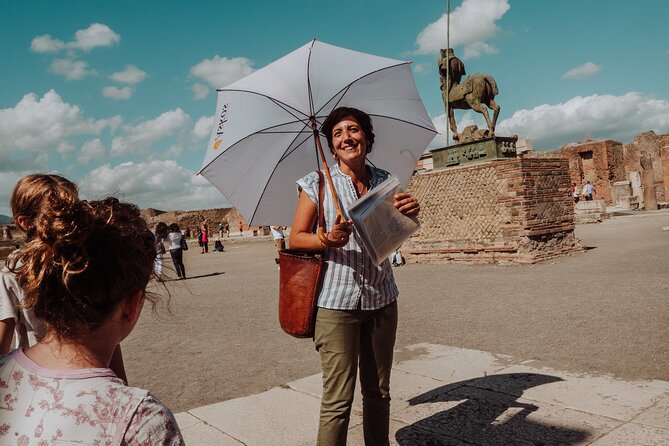
Your tour begins at the main entrance area of the archaeological site called Porta Marina Superiore. The guide meets you there holding a sign with the Askos Tours name at the top. You get about 10 minutes for the first stop, and admission is included.
This first moment is more important than it sounds. Pompeii is not laid out like a museum. It is a working archaeological landscape. A good guide helps you learn how to read it fast: where you are in relation to the Forum, how the street grid shapes movement, and why some areas look “obvious” once someone points out what used to be everyday life.
Even if you have photos saved in your head, entry orientation helps. You will spend less time asking yourself what to notice, and more time noticing it.
The Basilica portico: a shelter for merchants and movement
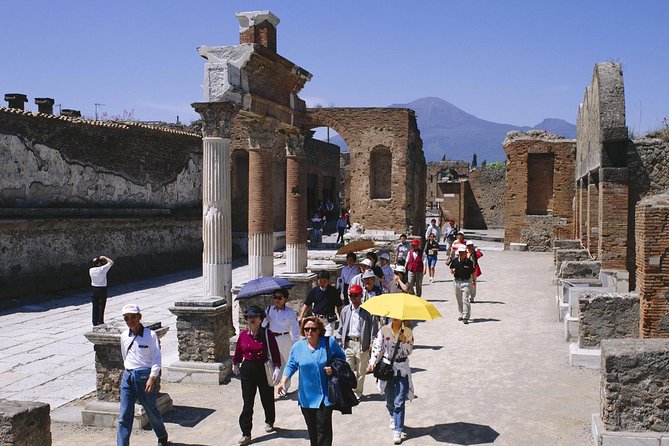
Next up is the Basilica, described as an open portico that provided shelter to merchants and other activities. Expect about 15 minutes here.
This stop is a great example of how Pompeii rewards context. Without explanation, you might see columns and think decoration. With guidance, you start to understand how public spaces worked, how people would pass through, and how economic activity blended into daily walking routes.
The drawback: since this is about a portico structure and civic function, you might want to ask extra questions if you love architecture for its own sake. A passionate guide can connect it to real routines, but your attention span at this stage matters. If you are prone to photo marathon mode, keep an eye on the story being told, not just what looks good in the frame.
A few more Pompeii trips worth comparing
- From Naples: Pompeii Skip-the-Line Entry Ticket and Tour
★ 4.4 · 2,753 reviews - Pompeii: Skip-the-Line Entrance Ticket with Audio Guide
★ 4.0 · 2,509 reviews - Pompeii: Archaeological Park Tour with Ticket on request
★ 4.5 · 2,283 reviews - Pompeii: Guided Walking Tour with Entrance Ticket
★ 4.3 · 1,423 reviews
Foro de Pompeya: the ancient main square and the pulse of the city
Then you get to the Foro de Pompeya, the ancient main square. It is a short stop, about 10 minutes, and it is central to understanding how Pompeii organized power and public life.
For me, the Forum areas are where you see the city’s logic. People were not just wandering for fun. They were moving between civic space, shops, and household entrances. You are also likely to start seeing why guides emphasize roads, thresholds, and corners. Pompeii ruins are built for movement, and the Forum is where movement concentrates.
This is a strong stop if you like big-picture understanding. If you want intimate domestic details only, you may find yourself tempted to sprint ahead. Use this as your anchor: let it set the map for everything that follows.
Walking the main street: when ruins start to feel like a route
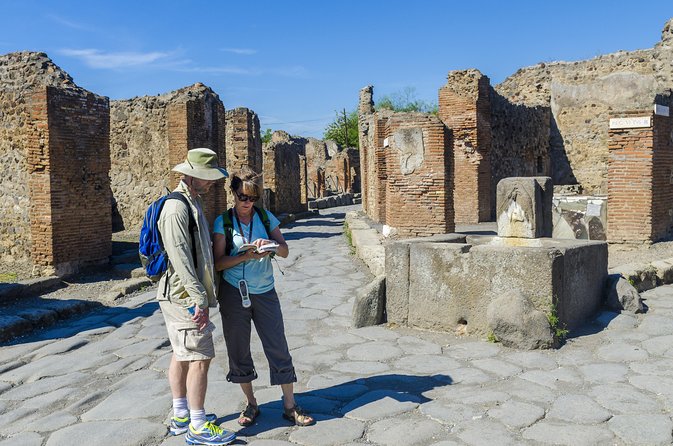
After the Forum, the tour moves along the main street of Pompeii. The itinerary calls for a “walk through the main street,” and this is one of those in-between moments that often becomes a highlight.
Why? Because streets are the glue. When you walk a corridor, you can imagine where people would pause, where noise would gather, and where the city’s rhythm would slow down. A guide helps you picture not just what the buildings were, but what a person’s day might have felt like moving between them.
Practical tip: wear shoes you trust. Pompeii has uneven surfaces and you will likely be stepping around stone edges. The tour recommends comfortable shoes and moderate physical fitness.
Granaries of the Forum: marble tables, fountains, and casts
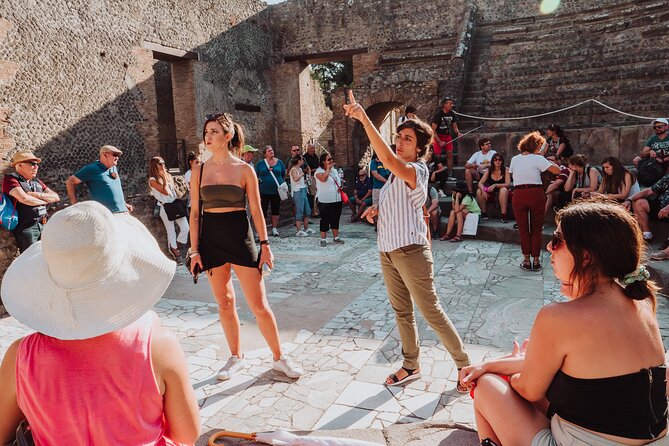
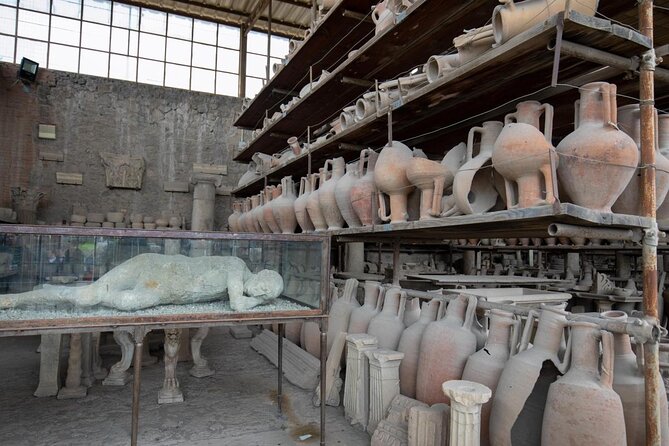
The Granaries of the Forum come next, about 15 minutes. This area includes marble tables and baths for fountains that adorned entrances of houses. It also includes casts of victims of the eruption, plus casts of a dog and a tree.
This is one of the stops where “you can’t miss it” becomes “you need to be ready for it.” The information here is emotional and direct. The casts are part of how modern visitors understand tragedy from physical evidence. A good guide does two things well: they explain what the site shows, and they avoid turning it into sensational shock.
If you are traveling with kids, this is a stop where a well-regulated explanation helps a lot. In the feedback, guides such as Rafaella are praised for keeping children engaged, and that kind of age-aware pacing can really matter here.
A possible drawback: because the casts and installations take attention, you might want more time than the itinerary gives. Still, in a two-hour structure, this stop gives you a meaningful emotional anchor before you pivot into daily-life zones.
House of Menander: luxury you can actually see and read
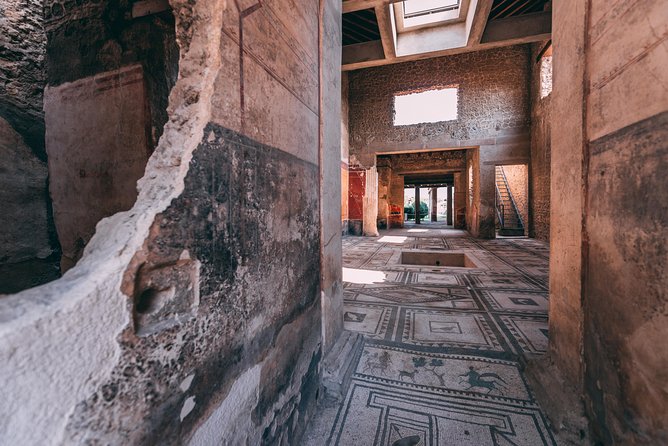
The House of Menander is one of Pompeii’s richest and most magnificent residences in terms of architecture, decoration, and contents. You get about 15 minutes.
This is your domestic stop that teaches you how status showed up in space. In Pompeii, a house is not just a house. It is a social stage. A guide helps you notice what points to wealth, what indicates how rooms were used, and which details were meant to impress visitors.
The value here is that you are not only looking at ruins. You are learning a way to interpret them. If you like architecture and art details, this is one of the best moments on the route.
Stabian Baths (Terme Stabiane): the oldest thermal complex feel
Next: the Stabian Baths, also called Terme Stabiane, about 15 minutes. These occupy a large area and are described as the oldest thermal complex in the city.
Bath culture in Roman life was social. Baths were about cleanliness, yes, but also about chatting, meeting, and spending time. A guide’s job here is to connect the layout to behavior, so you can imagine people moving through rooms and routines.
One practical consideration: this stop is bigger than it looks on a map, and you may be walking through open areas within the baths complex. Plan for sun or breeze, and remember this tour runs in all weather conditions. Dress appropriately and keep an eye on your stamina.
Lupanar: Pompeii’s famous brothel, explained with care
The Lupanar is the most famous brothel in Pompeii, and you spend about 15 minutes here. This is a high-interest stop for many people, and it also can be awkward if you do not want that kind of subject matter.
The key is how the guide frames it. The tour aims to provide context, not just shocking detail. A good archaeologist-led guide can talk about the space, the signs, the function, and the social system that produced it, while keeping the tone appropriate.
If you are traveling as a group with mixed preferences, this is the stop where you may want to signal your comfort level early. Private touring makes that easier. You can also ask for an explanation focused on architecture and everyday life rather than graphic storytelling.
House of the Faun: a large private residence with major impact
Then comes the House of the Faun, about 15 minutes. It is described as one of the largest and most impressive private residences in Pompeii.
This is another architecture-forward home base. Here, you are looking for scale and organization. A larger residence helps you see the range of wealth and the way space worked across a household. You will likely spend time understanding entrances, courtyards, and how rooms connected.
If you are a first-timer, this is a great payoff stop because it shows you what “impressive” looks like without needing to jump between too many locations.
Teatro Piccolo and Teatro Grande: two theaters, one city’s public life
The tour wraps with a look at Teatro Piccolo, followed by Teatro Grande, the most important theater in Pompeii. Teatro Piccolo is a quick stop, then Teatro Grande is about 10 minutes.
Theaters are public culture in stone. In Pompeii, they help you connect everyday life to communal entertainment and civic rhythms. The best way to enjoy these stops is to think in terms of sightlines and crowd movement. Even in ruins, a guide can help you imagine how people would have filled the space.
This final stretch is also where your energy matters. Pompeii is not a sit-and-stare site. If you are tired, take the guide’s lead, grab a few photos, and focus on the explanation. Save long photo sessions for later, outside the tour window if you have time.
What you gain from an archaeologist guide (and why it shows up in reviews)
The reviews you provided point to a pattern: people leave praising the guide, not just the sights. That makes sense. Pompeii is full of details, but it is hard to interpret alone. Guides like Alessandra, Silvia, Ivan, Luca, and Diego are praised for turning Pompeii into something you can picture, explain, and remember.
Here is what that usually means in real life for you:
- You learn what to notice, not just what you are looking at.
- You get answers to the questions you would have asked anyway, like what a space was used for.
- You get pacing that respects your group, including taking a bit slower over rough or steep ground when needed.
If you love clear, patient explanations, this tour is likely a good fit. If you want to sprint, the “private” format still allows you to move, but the guide may nudge you toward meaningful context rather than pure speed.
Who this Pompeii private tour is best for
This tour is a strong match if you:
- Want expert-led clarity in a short time window
- Are traveling with kids and want structured storytelling that keeps them engaged
- Prefer a non-rushed pace over big-group chaos
- Like to ask questions and adjust focus based on what you find interesting
It may be less ideal if you:
- Want half-day wandering with many long breaks
- Have very limited tolerance for uneven ground and stair-like edges
- Want a deep, hands-on style archaeology experience beyond a 2-hour overview
Remember: the tour is listed for travelers with moderate physical fitness, and comfortable shoes are recommended.
Should you book this Pompeii 2-hour private tour?
I think you should book it if you want a smart, time-efficient Pompeii visit where the site becomes understandable fast. The value comes from archaeologist-level context, the private pace, and the fact that Pompeii entry admission is included right from the start.
Skip it if you are the type who needs lots of unstructured wandering time, or if you plan to take long breaks every stop. In that case, you might prefer a longer tour or self-guided time. But if you want the “I get it now” feeling without the stress of sorting out the ruins alone, this is an excellent way to spend two hours in Pompeii.
Recently reviewed around Pompeii
- Pompeii Audioguide – TravelMate app for your smartphone★ 3.9 · 10 reviews
- Pompeii: AR Glasses Augmented Reality Tour★ 5.0 · 3 reviews
- Pompeii: Entrance Ticket – Skip the Line★ 3.8 · 64 reviews
- Pompeii: Entry Ticket & Guided Tour with an Expert Historian★ 5.0 · 4 reviews
- Pompeii Small Group Tour – Tickets Included★ 4.7 · 72 reviews
- Pompeii: Skip-the-Line Ticket and Virtual Museum★ 4.5 · 66 reviews
- From Naples: Pompeii & Mount Vesuvius Full-Day Private Tour★ 4.5 · 4 reviews
- Pompeii with Wine Tasting Private Tour★ 4.7 · 6 reviews
Pompeii Tours, compared.
Entry Ticket and Guided Tour with an Archaeologist
Read our review →

Pompeii Small Group Tour with an Archaeologist
Read our review →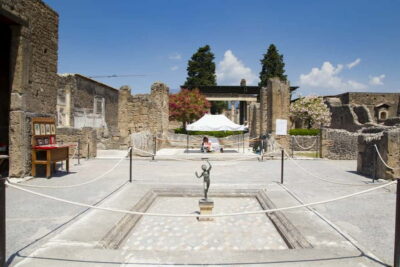
Naples or Sorrento: Full-Day Pompeii and Mount Vesuvius Tour
Read our review →
Pompeii & Mt.Vesuvius Day Tour from Naples with Pizza Lunch
Read our review →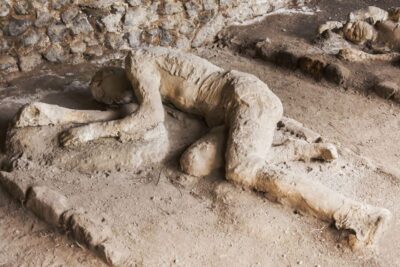
Browse the lists this tour appears in