

Reviewed · POMPEII TOURS
Sharing Tour of Pompeii
Pompeii is one of those places where you can’t help but feel the shock of history. This 2.5-hour sharing tour keeps it focused, hitting three big sights tied directly to Vesuvius and the careful work of excavation. It is also set up for real life, with pickup offered and a mobile ticket.
I like that you get a private tour guide for your small group (up to 8), and the whole thing runs in English. I also like that the meeting point is very clear, with your guide waiting under a Sharing Tour of Pompei sign.
One thing to think about: the Pompeii entrance ticket is not included in the tour price. You will still need to budget around the separate ticket cost per person, and because this is a sharing tour with a minimum number required, there is also a slim chance of cancellation close to departure.
Key Highlights Before You Go
- A tight 2.5-hour route that focuses on key Pompeii sites instead of wandering all day
- Small group size (up to 8) with a dedicated guide who can answer your questions
- Casa dei Vettii lets you connect the home’s art to the people named in its story
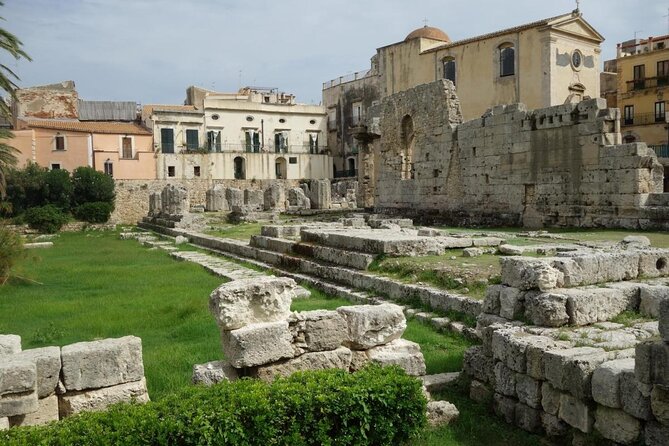
- A Roman temple stop gives you a quick look at how sacred space worked in the city
- The lupanari explains Pompeii’s early commercial side with clear context for what you are seeing
- Mobile ticket plus pickup offered means less hassle on the day
Why This 2.5-Hour Pompeii Route Feels Smart
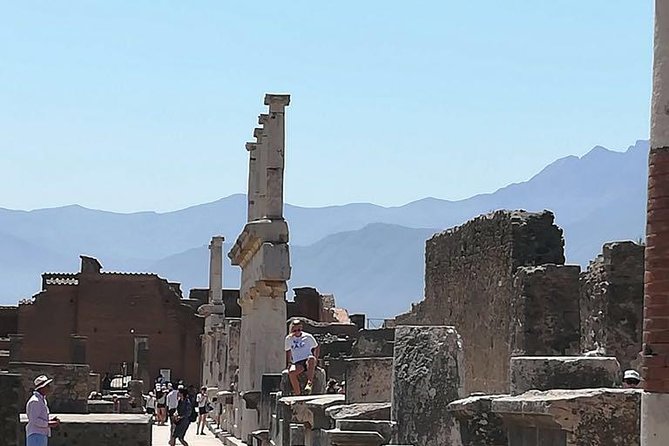
If you only have a half day in Pompeii, this kind of tour route makes sense. Two and a half hours is long enough to get oriented and still see meaningful pieces of the city. It is short enough that you are not stuck in a slow crawl through every corner of the ruins.
I also like that the stops share a theme: they each tie back to Pompeii’s destruction in 79 AD and the later archaeological work that brought the city back into view. Instead of treating Pompeii like a pile of random ruins, this tour helps you see how different places in Roman life were preserved and uncovered.
For many first-time visitors, the biggest value here is mental order. You walk in, you get structured stops, and you leave knowing what you just saw and why it matters.
More Pompeii tours and tickets in Pompeii:
- Pompeii: Entry Ticket and Guided Tour with an Archaeologist
★ 4.8 · 19,459 reviews - Pompeii: Entry Ticket with Optional Audio Guide
★ 4.2 · 12,360 reviews - Pompeii: Small Group Tour with an Archaeologist
★ 4.8 · 12,264 reviews
Meeting Point at Pompei Scavi, Villa Dei Misteri, and How Pickup Works
The meeting point is at Pompei Scavi Villa Dei Misteri 80045 Pompei. The good news is you are not left guessing. Your guide is waiting for you with a sign that reads Sharing Tour of Pompei.
Pickup is offered, which matters because Pompeii’s public transport and parking can be a puzzle, especially if you are traveling light or hopping between stops. Even if you do not use pickup, this meeting spot is described as being near public transportation, so you have options.
I recommend you plan to arrive a little early. Not because the tour is complicated, but because meeting-point logistics in Pompeii can still take a few minutes when you are finding the right entrance area.
Stop 1: A Roman Temple Buried by Vesuvius, Then Recovered
The tour starts with a Roman temple. You are looking at sacred architecture that was buried by the eruption of Vesuvius in 79 and later recovered through excavation.
What I like about this stop is the framing. A temple is one of the easiest ways to understand the city’s public life. Even if you are not a walking architecture nerd, you can still grasp the basic idea: this was a place tied to community worship and Roman civic identity.
The drawback is that temple spaces can feel visually repetitive compared with homes or the lupanari. If you love detail and you have time, you might want a longer visit later. But for a 2.5-hour tour, the temple is a strong way to set the stage quickly.
Practical tip: wear shoes you trust. Pompeii is uneven in many areas, and even short walks feel longer when you are staying attentive for details.
Stop 2: Casa dei Vettii, a Roman Domus Named for Its Owners
Next up is the Casa dei Vettii, a Roman domus. This is the kind of stop that helps you stop thinking of Pompeii as ruins and start thinking of it as real homes.
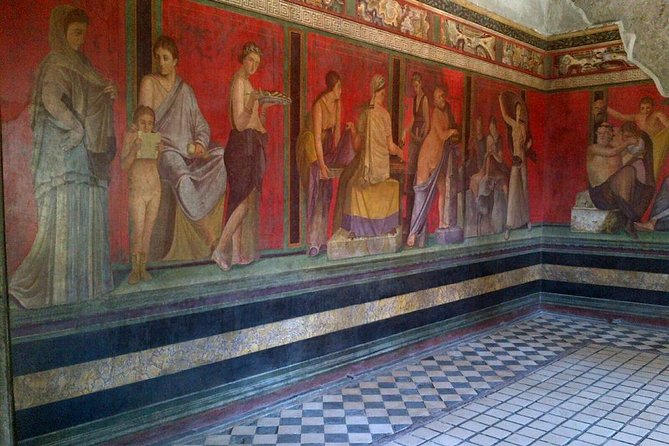
Here is the key story thread you will likely hear: the house was buried during Vesuvius’ eruption and later found during excavations. It is named after the owners, the Vettii, and it is described as one of the greatest examples of Roman art from the first century.
I really like this combination of art and identity. When a place is named after the people who lived there, it pulls you out of general history and pushes you into something more human. You get a clear sense that Roman domestic spaces were not just functional. They were also places where taste, wealth, and status could show up through decoration.
One consideration: a domus can be easy to photograph but hard to take in all at once. On a short tour, you might feel like you have to choose what to focus on. That is where a guide helps. Ask your guide what to look for first, then you can stop multitasking and actually see.
A different sort of day around the Bay of Naples:
- From Naples: Pompeii Ruins & Mount Vesuvius Day Tour
★ 4.3 · 11,459 reviews - Pompeii Small Group Tour with an Archaeologist
★ 5.0 · 6,593 reviews - Naples or Sorrento: Full-Day Pompeii and Mount Vesuvius Tour
★ 4.6 · 4,235 reviews - Pompeii & Mt.Vesuvius Day Tour from Naples with Pizza Lunch
★ 4.0 · 2,901 reviews
Stop 3: The Lupanari and What It Means in Roman Pompeii

The final stop is the lupanari. The tour frames it from the Latin lupa, tied to prostitution. During the Roman period, these were described as places dedicated to mercenary sexual pleasure, basically appointment houses or brothels, and some are still visible in Pompeii’s ruins.
I appreciate how this stop is explained as a named institution, not just a shocking fact. When you get the language and purpose upfront, you understand what you are looking at without turning it into pure spectacle.
It also adds balance. Pompeii is often presented through temples and homes, but Roman cities had businesses and services that kept daily life running. The lupanari helps you see the city as a full social system, not just a museum.
A potential drawback for some people: the subject matter can feel uncomfortable. If you know you would rather keep a distance from adult-themed topics, this stop might not be your favorite moment. Still, for many visitors, it is the part that makes Pompeii feel most like a real city.
English-Language Guide, Small Group Pace, and What You Should Expect
This is offered in English, with a private tour guide for your group. You are not dealing with a giant crowd, and that matters inside Pompeii where the ground, pathways, and sightlines can make big groups harder to manage.
In practice, a smaller group pace is usually better for two reasons. First, you can ask questions and get answers that connect directly to what you are standing in front of. Second, you can adjust your speed. If something grabs your attention, you do not have to feel like you are missing the tour bus.
This tour also uses a mobile ticket. That is a practical win if you do not want to juggle paper confirmations while walking through ruins and transit stations.
Price and Value: What $193.49 Per Group Really Means
The price is $193.49 per group for up to 8 people, and the tour lasts about 2 hours 30 minutes. That is the headline.
Now the part you need to budget for: the Pompeii entrance ticket is not included. The tour notes 20 euros per person and says tickets are bought daily for customers. So your real cost is the group price plus the entrance ticket per person.
Here is the value math in plain terms:
- If you fill the group with 8 people, you are effectively paying about $24 per person for the tour portion, before the ticket.
- If you have 4 people in your group, the tour portion jumps to roughly $48 per person, before the ticket.
That means this option shines when you can go with others and share the group cost. If you are solo, it can still be worth it for the guide value, but you should be prepared for the entrance ticket to be a separate line item either way.
Also, because it is booked on average 50 days in advance, popular slots can disappear. If you are traveling in a busy season or have tight timing, booking earlier is the safer move.
Scheduling Reality: Minimum Numbers and Late Changes
This is where I want you to be practical. The tour requires a minimum number of travelers. If that minimum is not met, you are offered a different date/experience or a full refund.
The useful takeaway is not to panic, but to plan with awareness. Keep an eye on your email the day before and the day of. One person described a late notice that the tour would not take place. That experience is exactly the kind of thing that can happen with minimum-number operations, so the best defense is staying alert close to departure.
If your schedule is rigid, consider building in buffer time so you can swap to another Pompeii option if needed.
Who This Pompeii Sharing Tour Fits Best
This tour is a strong match if you want:
- A focused Pompeii highlight route in a short amount of time
- English guidance that helps you interpret what you are seeing
- A small group feel (up to 8) rather than a big rush
- A mix of temple, home, and the lupanari, so Pompeii feels like a whole city
It may be less ideal if you want to linger for hours at one site, or if you already know Pompeii deeply and you are hunting for very specific, obscure corners. In that case, a longer dedicated visit may suit you better.
Should You Book This Sharing Tour of Pompeii?
I would book it if you fit the sweet spot: you have around half a day, you want structure, and you care about understanding what each stop represents. The combination of a Roman temple, the Casa dei Vettii, and the lupanari gives you a balanced snapshot of Pompeii’s Roman world, not just one narrow angle.
One more decision rule: if you can join with others and make the group size closer to 8, the value usually looks best. Also, budget for the 20 euros per person entrance ticket, since that cost is separate.
If your time is tight, book early and keep an eye on communications because minimum-number cancellations can happen. If you can stay flexible, this is a clean, efficient way to see Pompeii with an English guide and walk away with a clear mental map.
Recently reviewed around Pompeii
- Pompeii, Herculaneum, and Vesuvius: Full-Day Tour★ 3.7 · 21 reviews
- Pompeii & Herculaneum Group Tour with tickets★ 4.9 · 13 reviews
- Pompeii Guided Tour with Archaeologist★ 4.6 · 27 reviews
- Pompeii, Herculaneum and Vesuvius Tour★ 3.4 · 9 reviews
- Pompeii Guided Tour with Archeologist★ 4.9 · 19 reviews
- Pompeii: Skip-the-Line Tour for Kids and Families★ 4.9 · 72 reviews
- Pompeii: 2H group guided tour with a certified guide★ 3.4 · 8 reviews
- Pompeii: Guided Tour & Skip the Line Ticket★ 4.9 · 8 reviews
Pompeii Tours, compared.

Entry Ticket and Guided Tour with an Archaeologist
Read our review →


Pompeii Small Group Tour with an Archaeologist
Read our review →
Naples or Sorrento: Full-Day Pompeii and Mount Vesuvius Tour
Read our review →
Pompeii & Mt.Vesuvius Day Tour from Naples with Pizza Lunch
Read our review →
Browse the lists this tour appears in