
Reviewed · POMPEII TOURS
Pompeii Private Tour with an Archaeologist Guide
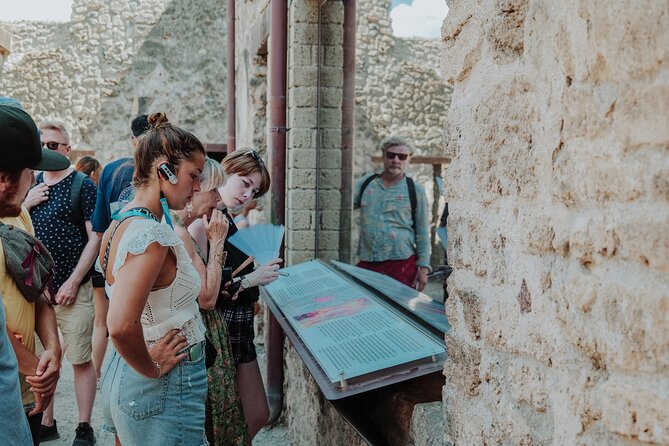
Pompeii can feel like a pile of ruins until someone gives you the right map in your head. This private tour with an archaeologist helps you connect buildings to daily life, jobs, food, and social status. It is also one of the few ways to ask questions without feeling rushed or lost in the flow.
Two things I like a lot: you get undivided guide attention on a private format, and the route covers key Pompeii sights in about 2 hours, including places like the Stabian Baths and the Forum area. The main drawback to plan for is cost creep, because the Pompeii entrance ticket is not included, so you will pay that separately on top of the tour price.
Key reasons this Pompeii private tour works
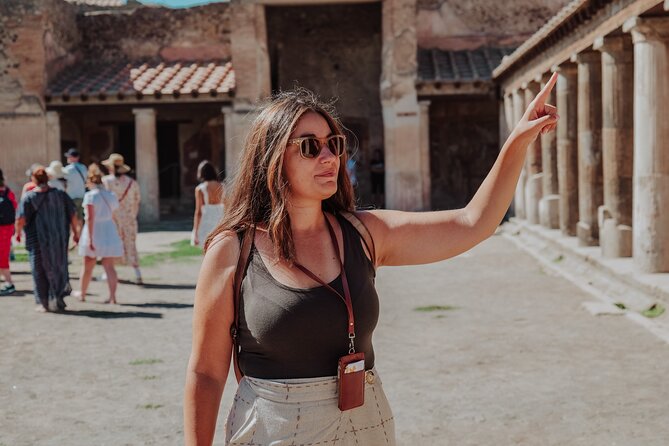
- Archaeologist guidance that turns ruins into lived-in places
- Private pacing, so you can slow down, speed up, and ask questions
- A smart highlights route that covers big names like Casa dei Vettii and the Forum zone
- Frequent “stop and explain” moments, not just a long walk
- Help with the practical stuff after the tour, including getting back to your accommodation or the nearest train station
Entering Pompeii via Porta Marina Superiore, with a guide who sets the scene
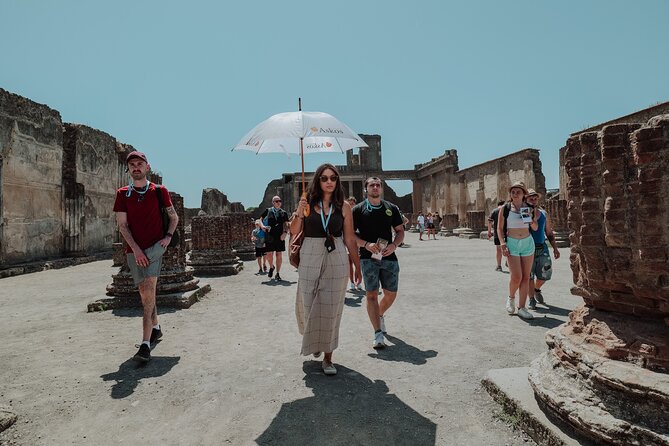
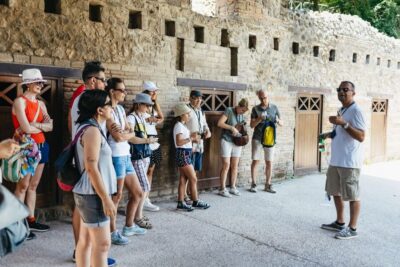
The tour begins at the main entrance of the Archaeological Park of Pompeii, Porta Marina Superiore. Your guide will be holding a sign that has the company name Askos Tours on it, so you are not left guessing who to follow. The meeting point is also listed as Via Villa dei Misteri, 1, Pompei NA, Italy, and the end point is the same place.
What I like about starting this way is psychological. Pompeii is huge, and arriving with a guide who gives you a quick orientation helps you stop wandering around like you are looking for the one correct selfie spot. You also get to settle into the rhythm of the day, which matters because Roman streets are not flat and they do not forgive flip-flops.
A heads-up on tickets: the tour price covers the archaeologist guidance and the private format, but you are responsible for the Pompeii entrance ticket. After you are inside the site, you move through the key areas with your guide.
More Pompeii tours and tickets in Pompeii:
- Pompeii: Entry Ticket and Guided Tour with an Archaeologist
★ 4.8 · 19,459 reviews - Pompeii: Entry Ticket with Optional Audio Guide
★ 4.2 · 12,360 reviews - Pompeii: Small Group Tour with an Archaeologist
★ 4.8 · 12,264 reviews
Casa dei Vettii: a home that explains status in one building
Casa dei Vettii is one of Pompeii’s best examples for understanding how wealth showed up in everyday details. Here, your guide can point out the kind of wall art, layout, and features that signal the owners were not just comfortable, they wanted their home to say something about them.
On a private tour, this stop matters more than you might expect. In a group setting, you tend to “look” and move on. On this format, you can linger where you feel curious. If you have questions about what you are seeing, this is the part where your guide can start training your eye to spot the story in the stone.
The Lupanar and Roman street realism
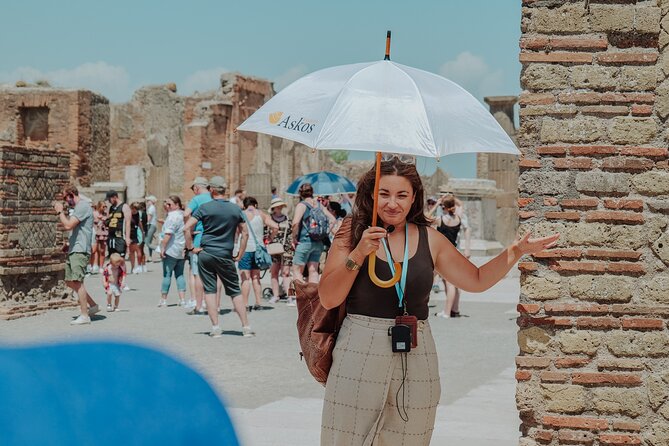
Next up is the Lupanar, a small but fascinating Pompeii site tied to how commerce and services worked in the city. This is not the kind of stop that feels like a generic museum room. Instead, you are looking at a space that helps you understand how people lived in a city that mixed public life and private transactions.
If you have teens or you just like frank history, this tends to land well. Many guides use modern comparisons to help you understand the function of the rooms and the signage. The private format helps too, because you can decide how much time you want here.
One consideration: Pompeii can be warm, and this part of the city can feel like you are moving through tight spaces. Wear comfortable shoes and be ready to pause and check your footing.
House and Thermopolium of Vetutius Placidus: food, trade, and the “fast stop” culture
After Casa dei Vettii and the Lupanar, the route moves to the House and Thermopolium of Vetutius Placidus. The word thermopolium basically points to a Roman hot-food counter, a place where people could stop for something to eat without cooking at home.
This is where Pompeii becomes more than art and architecture. It is about daily rhythms: work, errands, meals on the go, and the local economy doing its thing. You will likely catch how the layout supported quick service, and your guide can connect it to the wider street network.
If you like history that feels practical, this is a strong stop. If you are trying to “speed-run” Pompeii, it is also a good place to reset your expectations, because you start thinking like a person on the street, not a person looking at postcards.
More private tours in Pompeii:
- Pompeii Ruins Private Tour with Optional Skip-the-Line Entry
★ 4.9 · 732 reviews - Pompeii private tour with an Official Guide
★ 5.0 · 631 reviews - Pompeii Private Tour with an Archaeologist and Skip The Line – 3 hours
★ 5.0 · 564 reviews - Visit in Pompeii – Pompeii Private Tour with Ada
★ 5.0 · 436 reviews
Teatro Grande: a quick hit of entertainment culture
The route includes Teatro Grande, the big theatre space. This is a shorter stop, but it has an outsized payoff. Even if you only get a few minutes, the theatre helps you round out the city picture: Pompeii was not just commerce and homes, it also had organized entertainment.
In a private tour, this kind of short stop is useful because it prevents the whole tour from becoming a long series of houses. You get variety, and your brain gets a breather.
House of the Faun and House of Menander: walking through elite interiors
The tour then touches two major houses: the House of Faun and later the House of Menander. These stops focus on how wealth showed up in architecture, layout, and decor.
Here is the value of an archaeologist guide, even in only two hours. You are not just seeing what a house looks like. You are learning how rooms worked, what visitors likely noticed, and how the home connected to street life. Roman houses were not sealed off bubble worlds, they were part of the city’s social system.
The reviews for this tour style consistently emphasize guides who make Pompeii feel understandable. Names like Paolo, Jolanda, Silvia, Michele, Vito, and Raffi show up again and again in different guide styles, but the shared theme is the same: houses get explained like real places, not just stone shells.
Stabian Baths and the city’s “daily reset” idea
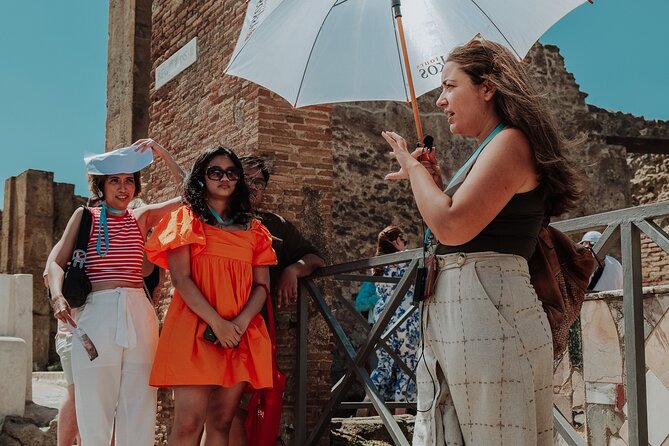
The Stabian Baths, also called Terme Stabiane, are a highlight for many visitors because they show how public routines worked. Bathing was not only about cleanliness. It was also social time, and it was part of how the city stayed connected.
This stop is also a great place to slow down a bit. The baths can take a moment to “read” as a system, with different areas serving different functions. A good guide helps you see the flow, not just the ruins.
If you are visiting in hot weather, the baths can give you a surprising angle. You can understand how people planned around the heat and how spaces were designed for comfort. Even a short stop can help you notice details you would otherwise miss.
Via dell’Abbondanza: street life, not just buildings
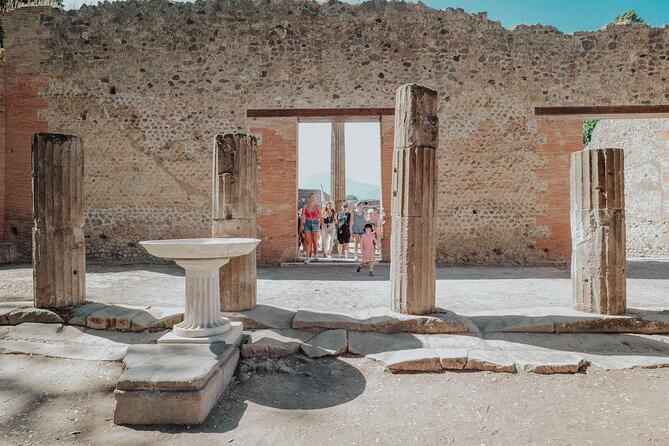
Next is Via dell’Abbondanza, the famous main street. This is one of those Pompeii sections that can feel obvious until your guide shows you how to look. Street life is where the city’s “how it worked” comes through: movement, storefronts, and the connections between major sites.
This is also where you can learn faster than you expect. Walking the street with explanations gives you a sense of orientation that makes the remaining stops easier. When you know where you are in relation to the Forum zone and major buildings, the site stops feeling random.
Practical note: Pompeii surfaces can be uneven. This is why the simple advice matters, closed shoes are the right call. Flip-flops can be a bad idea, and you will spend more time watching your step than absorbing history.
Forum Baths, Macellum, Granaries, and the Forum itself
The late tour focus moves into the Forum zone, including Forum Baths, the Macellum, Granaries of the Forum, and finally the Foro de Pompeya (the Forum).
This cluster is where Pompeii becomes a working city. The Forum is the civic heart, and the nearby buildings show how people lived out everyday needs and business. The Macellum helps explain markets, while the granaries connect to food supply. The Forum Baths reinforce the idea that public spaces were part of daily routine, not just leisure.
The Forum Baths and Forum area also offer a “big picture” moment. If you have only limited time, this is where the guide’s storytelling helps you stitch everything together. It can feel like the city has a heartbeat.
One caution: because the Forum zone is central, it can also be crowded at peak hours. A private guide can often help you time your movement and choose the moments to look, so you spend more minutes understanding than waiting in bottlenecks.
Price and logistics: is $178.45 per person worth it?
At $178.45 per person for about 2 hours, this is not a budget tour. You are paying for three things: a private format, archaeologist-level guidance, and a route designed to hit major points without wasting your time.
When it is worth it:
- You only have a short window in Pompeii and you want a coherent experience.
- You care about daily life, not just famous spots.
- You want to ask questions and get answers that connect rooms, streets, and functions.
When you might reconsider:
- If you are comfortable doing Pompeii on your own with a book or audio guide and you do not mind guessing what you are looking at.
- If you hate the idea of paying extra for the Pompeii entrance ticket, because that is separate from the tour price.
Also factor in pacing. Two hours is a lot, but Pompeii is enormous. In the same way you would not “fully understand” a major city in one coffee stop, you will want to treat this as an efficient highlights orientation. Many people end up adding extra time on their own afterward, especially if they fall in love with specific areas like the houses or the Forum zone.
What to expect from your guide (based on real guide styles)
The tour is led by an archaeologist guide, but the review stories show different strengths that can affect your experience.
Some guides are known for:
- Art and daily life explanations that make the houses feel human, not academic
- Route sense, getting around the busiest areas so you can keep moving
- Kid-friendly engagement, which can help if you are bringing younger travelers
- Modern analogies, useful for understanding how places like the thermopolium or street services worked
Names that appear across the guide reviews include Rossana, Mena, Mimma, Paolo, Jolanda, Silvia, Michele, Vito, Maria, Ivan, Antonella, Julia, Laura, Sara, and Raffi. That variety is a good sign. You are not getting one scripted talk, you are getting an expert who can tailor the pace to your curiosity.
Timing, pace, and comfort tips that actually help
The tour runs for about 2 hours. It includes multiple short stops, then a shift into the Forum zone near the end. That structure makes sense: you start with orientation, then go into the most important “reading stops” like houses and civic spaces.
Your comfort depends on a few practical choices:
- Wear closed shoes. Pompeii walking can be tough, and flip-flops can be annoying fast.
- Expect some walking on uneven surfaces.
- Use your guide’s “ask now” moments. If something is confusing, ask. The tour is set up so you can get answers while you are still standing there.
Also, the meeting point is in central Pompeii, and the guide will help with useful information for getting back, including how to reach your accommodation or the closest train station.
Who this Pompeii private tour fits best
This tour is a strong match if:
- You want Pompeii to feel understandable instead of overwhelming
- You prefer a private format where you control questions and pacing
- You value seeing key highlights like the Stabian Baths and the Forum area
- You want an English-speaking guide who can explain what you see clearly
It can be a good family option too, since guides on this type of tour have shown they can keep kids engaged. And even if you are not an “ancient Rome” person, you will likely find the focus on daily life is a smart entry point.
If you are a super detail-focused archaeology fan, you may still want longer than 2 hours. Pompeii rewards time, and two hours is best treated as the best possible first pass.
Should you book this Pompeii private tour?
Book it if you want a fast, high-quality orientation that helps you understand what you are seeing, not just where things are. The price makes more sense when you compare it to the time you save and the ability to ask direct questions at the sites that matter most.
Skip it or think twice if you already feel confident navigating Pompeii and interpreting what you see. In that case, a self-guided visit might be cheaper. But if you want Pompeii to click quickly, this private archaeologist format is a very good bet.
Recently reviewed around Pompeii
- Pompeii, Herculaneum, and Vesuvius: Full-Day Tour★ 3.7 · 21 reviews
- Pompeii & Herculaneum Group Tour with tickets★ 4.9 · 13 reviews
- Pompeii Guided Tour with Archaeologist★ 4.6 · 27 reviews
- Pompeii, Herculaneum and Vesuvius Tour★ 3.4 · 9 reviews
- Pompeii Guided Tour with Archeologist★ 4.9 · 19 reviews
- Pompeii: Skip-the-Line Tour for Kids and Families★ 4.9 · 72 reviews
- Pompeii: 2H group guided tour with a certified guide★ 3.4 · 8 reviews
- Pompeii: Guided Tour & Skip the Line Ticket★ 4.9 · 8 reviews
Pompeii Tours, compared.
Entry Ticket and Guided Tour with an Archaeologist
Read our review →

Pompeii Small Group Tour with an Archaeologist
Read our review →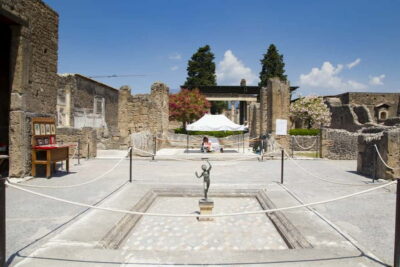
Naples or Sorrento: Full-Day Pompeii and Mount Vesuvius Tour
Read our review →
Pompeii & Mt.Vesuvius Day Tour from Naples with Pizza Lunch
Read our review →
Browse the lists this tour appears in