
Reviewed · PAESTUM TOURS
Paestum Tour: Best Preserved Temples in the World (UNESCO)
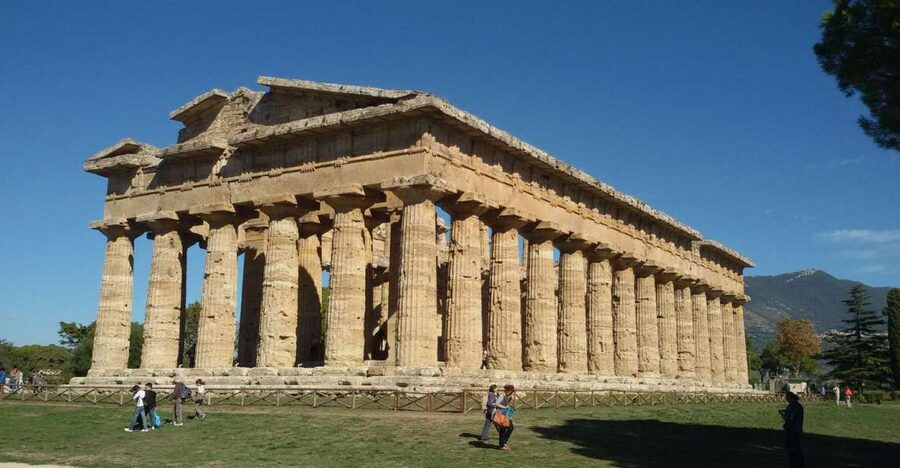
Paestum is interesting because the ancient stone still reads clearly, even when you are standing right in the middle of modern time. I like how this tour gets you up close to the perfectly preserved Hera and Poseidon temples, then ties it all together with museum masterpieces, including the Tomb of the Diver.
One thing to consider is that you are getting a focused 2-hour experience, and entrance tickets are not included, so you’ll want to plan your budget and arrive ready to pay admission on arrival.
Key highlights you’ll feel right away
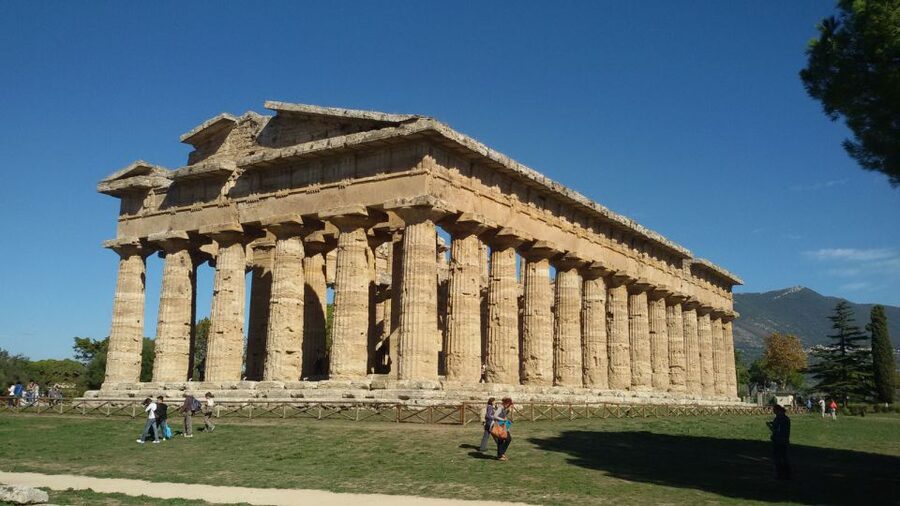
- Hera, Poseidon, and Ceres temples you can actually study, not just pass by
- Tomb of the Diver and other standout museum finds after the ruins
- Roman forum and amphitheater stops along the sacred Via Sacra route
- Clear architecture explanations that help you understand what you are seeing
- Private group format for up to 25 people, with a live licensed guide
- 2 hours on-site is tight, which makes timing and shoes matter
Paestum UNESCO in 2 hours, and why it works
Paestum sits in Campania and was first known in Magna Grecia as Poseidonia, later taking the Roman name Paestum. The founders and locals honored gods in a very specific way, with special devotion to Athena and Hera. That matters, because this tour is built around temples that reflect those choices, not a random walk through ruins.
What I like about this format is the pacing. You start outside, where the size and shape of Doric temples hit you in the face, then you shift indoors to put names and details to the art. If you only have a short window, this pairing makes the visit feel complete.
More Paestum temple tours:
- Paestum: Small-Group Tour with an Archaeologist and Tickets
★ 4.9 · 451 reviews - Paestum: 2-Hour Greek Temples & Archaeological Museum
★ 4.8 · 19 reviews - Paestum Greek Ruins
★ 4.5 · 15 reviews
Where the tour starts, and how to get oriented fast
The tour meets at the archaeological museum entrance in Paestum, and it ends back at the same meeting point. That simple loop is helpful. It means you do not have to worry about finding a new exit point or reorganizing your day around a different neighborhood or a later pickup.
When you arrive, take a minute to look at the big picture before the guide starts talking details. Paestum rewards you for stepping back mentally and asking a basic question: how did people move through the sacred space? Once you picture that flow, the temples and the Via Sacra stops make more sense.
Temple of Hera, the Basilica: Doric geometry you can measure with your eyes
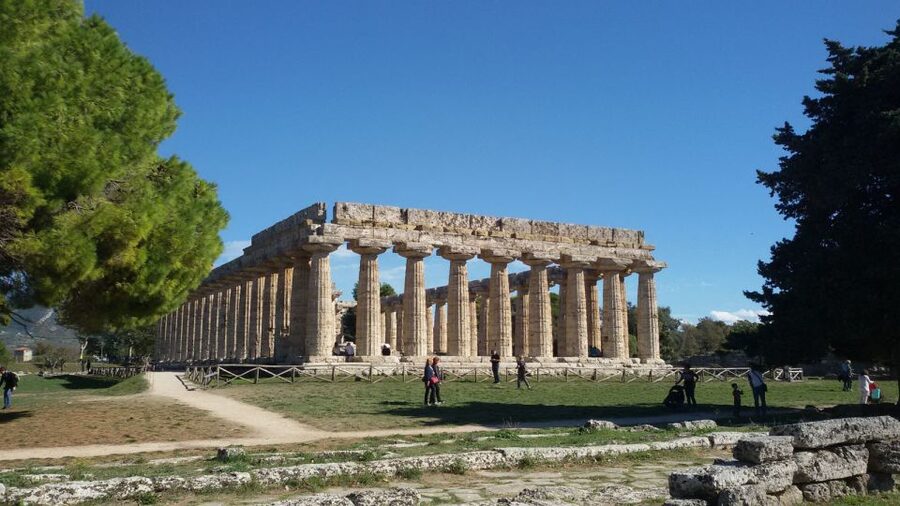
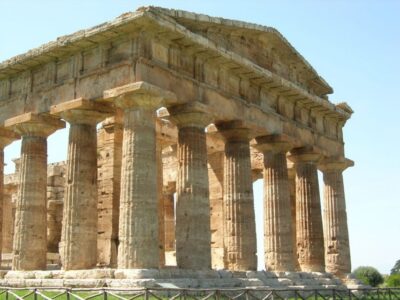
The first major stop is the Temple of Hera, also called the Basilica. It is described as the oldest temple on the tour, built in the Doric style, with impressive dimensions: 26 meters wide and 55 meters long.
Here is what you should pay attention to. Doric temples are all about proportion. Even if you do not know architecture jargon, you can see how the vertical rhythm and column spacing create balance. The guide’s job is to translate those patterns into something you can understand on the spot, which is one of the most praised parts of the experience.
Practical tip: look for how the scale feels from different distances. Up close, you focus on surfaces and column details. From farther back, you start to understand how the entire building reads as one strong shape.
Temple of Poseidon, also called Neptune: the biggest Doric statement
Next comes the largest temple on the tour, the Temple of Poseidon, also called Neptune. It is compared to the Temple of Zeus in Olympia and is described as a majestic Doric wonder built in 460 B.C.E.
This is where many first-time visitors do a mental reset. Paestum is not trying to be dramatic with color or spectacle. It is dramatic with mass and form. You are looking at a kind of monumental confidence that still holds up today.
If you are the type who likes to connect architecture to culture, ask yourself why a city would invest in something this large. In Magna Grecia, temple building was not only about worship, it was also about identity, power, and civic pride. The best preserved state here makes those messages easier to read.
A different sort of day around the Bay of Naples:
- Paestum: Temples and Museum Tour with Archaeologist Guide
★ 5.0 · 14 reviews - Paestum Archaeological Tour: 3-Hour Private Exploration
★ 5.0 · 3 reviews
Temple of Ceres and the more modest sacred space
The third temple is the Temple of Ceres. It is tied to a sanctuary dedicated to Athena, and it is described as more modest in size, but still exceptional.
Do not treat this as the small stop. The contrast is the point. When you have already seen the scale of Hera and Poseidon, Ceres helps you understand that sacred areas were not one-size-fits-all. Different buildings served different functions, and the complex’s design reflects those different needs.
When the guide explains the layout, listen for how the temples relate to each other along the sacred route, not just as isolated monuments.
Via Sacra moments: Roman forum and amphitheater
After the temple trio, the tour includes a walk along the Via Sacra, where you can see the Roman Forum and the amphitheater.
This is a great segment because it changes the time period on you. You start with Greek sacred architecture, then you shift toward Roman civic and public spaces. Even in ruins, the Roman additions help you picture how the site kept evolving after the Greeks. The forum hints at administration and public life, while the amphitheater suggests gatherings and performance.
Practical note: these are ruin views, so your angle matters. Stand where you can see both the general shape and the key remains. If you are taking photos, do not just shoot one front view, try one wider frame and one detail shot.
The National Archaeological Museum, where the story gets specific
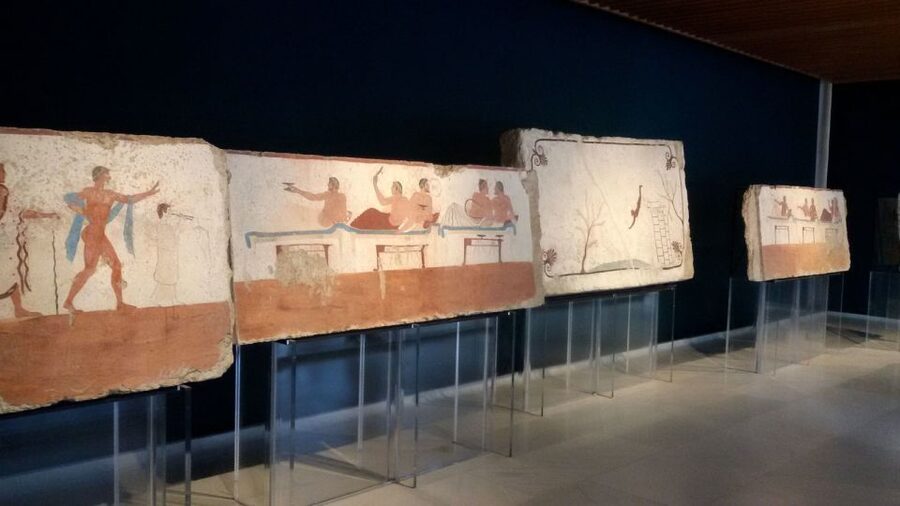
Once you finish the outdoor ruins, the tour ends at the National Archaeological Museum. This is where Paestum turns from impressive stone to named objects, faces, and scenes.
Inside, you can admire:
- Thirty-three metopes from the Temple of Hera Argiva
- A statue of Zeus
- A crater with the rat of Europe
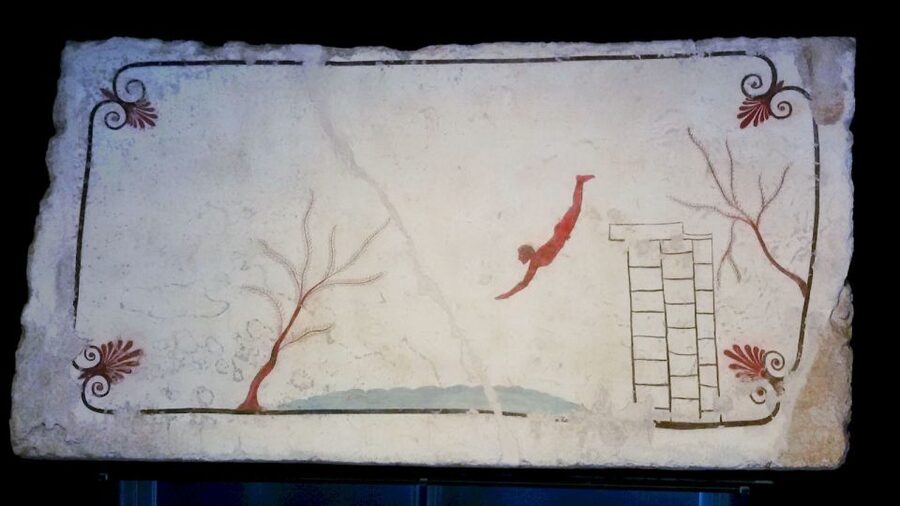
- The famous Tomb of the Diver
The standout is the Tomb of the Diver. It is described as a tomb made of five limestone slabs in local travertine plastered and decorated with parietal painting. The figurative subject is realized with the fresco technique.
Why this matters for you: fresco-style painting on a tomb is not just decoration, it is storytelling and symbolism in visual form. If the temples can feel abstract at first, the museum pieces give you anchors you can remember later.
What a good guide really changes on a temple tour
This tour is built around a licensed guide, and that is not just a checkbox. The best temple experiences happen when someone can point out what you are missing, then answer the questions you did not know you had yet.
The strongest praise you can take from the experience details is that the guide gives very good explanations of architecture and history and answers questions well. That matters because Paestum is visual, but it is also full of structure, names, dates, and styles. Without an interpreter, you risk walking away with a photo set and a vague sense of awe.
If you want to learn efficiently, ask the guide to explain what differentiates Doric temple choices or why the second and third temples change the story. You will likely get clearer takeaways than you would from reading alone.
Price and value for a private group up to 25
The price listed is $325.13 per group, up to 25 people, and the tour lasts 2 hours. On a per-person basis, that can be reasonable if you are splitting the cost with your group, especially because the tour includes the live licensed guide.
However, the entrance tickets to the archaeological park and the museum are not included. So your real total cost is going to depend on admission fees when you arrive or when you purchase them.
Here is the value equation I use:
- If you want a guided learning experience at Paestum without spending time figuring out what to look for, a guided format is often worth it.
- If you are traveling solo or as a couple, you may want to compare this private-group pricing against any smaller-group or self-guided options, since you are effectively paying for the group rate.
In short, it can be a good buy when you have enough people to make the group price work.
Timing, timing, timing: making the most of 2 hours
Two hours sounds short because it is. But Paestum is also a destination where the best use of time is quality, not quantity. The tour gives you a tight sequence: Hera, Poseidon, Ceres, then Roman Forum and amphitheater views, and finally the museum with the Tomb of the Diver.
To make those hours count:
- Wear comfortable shoes. You are walking ruins and museum space.
- Bring a layer if weather changes quickly. Campania can feel warm, then shift.
- If you care about photos, do them in two passes: one quick overview while the guide is explaining the layout, then a second sweep when you understand where to stand.
You are not trying to see everything in the region. You are trying to see Paestum well.
Languages: choose the guide experience that fits you
The tour offers live guidance in Spanish, English, French, German, and Italian. That matters more than people expect. When you can follow explanations clearly, you can ask smarter questions and get more out of the architectural comparisons and historical context.
If your group includes different language needs, confirm the language option when you book so nobody is stuck half-lost in a story that changes every minute.
Who this tour suits best
This tour is a strong fit if you:
- Want UNESCO-level ancient temples without doing a deep independent research project
- Like architectural details, proportions, and style distinctions like Doric features
- Prefer a guide who can answer questions rather than a headset audio loop
- Are traveling with friends or family and can make a private group price work
It may be less ideal if you want hours of free time wandering with no structure. This one is guided and time-boxed, so you are building a guided storyline, not a free-form explore session.
Should you book this Paestum temples and museum tour?
Book it if you want the fastest path to the three big temples and the museum’s major set pieces, especially the Tomb of the Diver. It is a smart use of limited time, and the guide quality is a central part of the experience.
Skip it or rethink if you are trying to do Paestum on a shoestring without factoring in separate admission, or if you prefer self-guided exploring with no scheduled structure. In that case, you might do better with independent entry and a slower pace.
If you are on the fence, this is my practical rule: if you will not enjoy reading labels and translating temple shapes on your own, a guided 2-hour run through Hera, Poseidon, Ceres, then the museum is an efficient way to leave Paestum with real understanding, not just photos.
FAQ
How long is the Paestum tour?
The tour duration is 2 hours. Starting times depend on availability.
Where does the tour start?
It starts at the Archaeological Museum entrance in Paestum.
Where does the tour end?
This activity ends back at the meeting point.
Is a guide included?
Yes, the tour includes a licensed guide.
Are entrance tickets to the archaeological park and museum included?
No. Entrance tickets are not included for the Archaeological Park and the National Archaeological Museum.
Is transportation or pickup included?
No. Transportation, pickup, and drop-off are not included.
Is the tour private?
Yes. It is a private group experience, up to 25 people.
What languages are available?
Live tour guidance is available in Spanish, English, French, German, and Italian.
What if I need to cancel?
You can cancel up to 24 hours in advance for a full refund.
Is there a pay-later option?
Yes. You can reserve now & pay later, keeping your travel plans flexible.
Recently reviewed around Paestum
- Paestum Archaeological Tour: 3-Hour Private Exploration★ 5.0 · 3 reviews
- Paestum: 2-Hour Greek Temples & Archaeological Museum★ 4.8 · 19 reviews
- Paestum: Temples and Museum Tour with Archaeologist Guide★ 5.0 · 14 reviews
- Paestum Greek Ruins★ 4.5 · 15 reviews
- Paestum: Small-Group Tour with an Archaeologist and Tickets★ 4.9 · 451 reviews
Paestum Tours, compared.
Small-Group Tour with an Archaeologist and Tickets
Read our review →
Temples and Museum Tour with Archaeologist Guide
Read our review →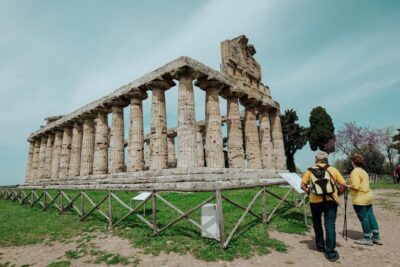
Paestum Archaeological Tour: 3-Hour Private Exploration
Read our review →Browse the lists this tour appears in