
Reviewed · NAPLES
Hypogeum of the Crystallines Standard Visit
What makes the Hypogeum of the Crystallines so interesting is how you walk into a real underground slice of ancient Naples and come out talking about color, myth, and daily life. I love the Greek-painted tombs that are still beautifully preserved, and I love that you actually walk along the ancient road of Neapolis. One consideration: this is an underground site with architectural barriers, so plan for stairs, uneven surfaces, and limited ease of access.
In practical terms, this is a short tour (about 25 minutes), so it works best when you want something focused rather than a long, slow crawl through multiple rooms. I like the tight pacing because it keeps the story moving, from the 1889 discovery tale to what you’re standing in front of. The only real drawback is the time limit, so if you prefer lots of time to linger and photograph, you may want to pair it with extra time elsewhere in Rione Sanità.
Key highlights at a glance
- 2400-year-old Neapolis underground, in a carefully guided visit
- Four Hellenistic tombs with painted details still preserved
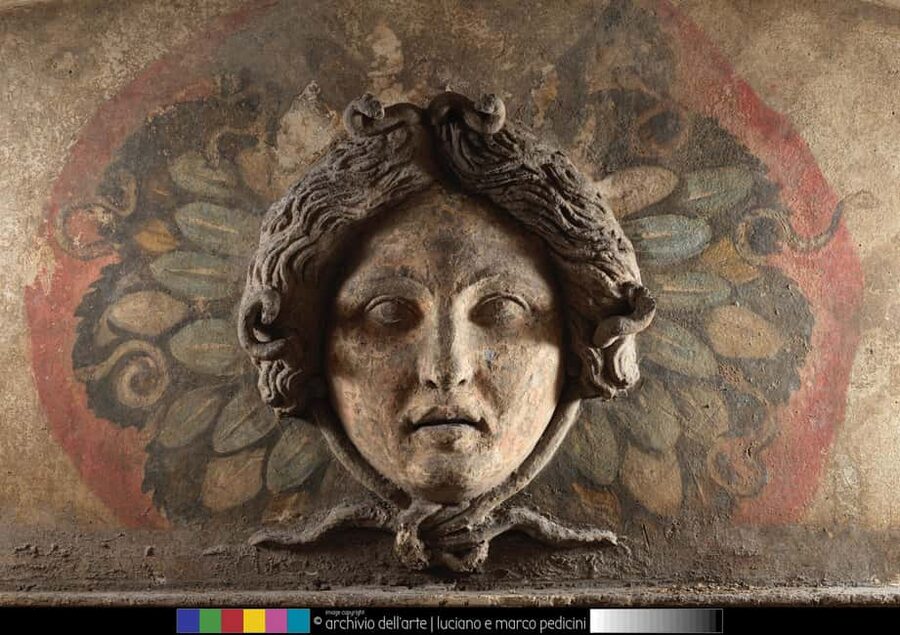
- A standout carved and painted Medusa, described as a unique unicum
- You walk the original street/ancient road of Neapolis
- You’ll hear the 1889 discovery story linked to Baron Giovanni di Donato
- A quick video with virtual reconstruction helps you picture what you’re seeing
Why This 25-Minute Underground Naples Visit Feels Like Time Travel
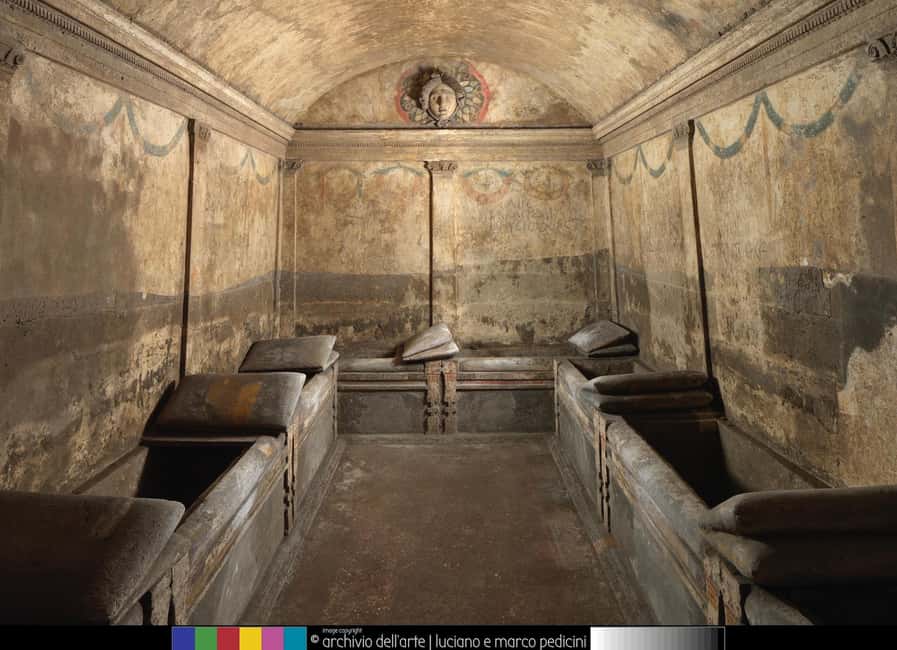
This is one of those rare Naples experiences where the setting is the main character. You descend 12 meters into the underground world and rediscover Neapolis, a Greek-era Naples space from the 4th century BC. The effect is immediate because you are not looking at a museum model. You are standing in the place itself.
I also like how the tour balances art and story. You get guided attention to the frescoes, architecture, and ancient myths, and the visit is organized so you don’t feel rushed through confusion. And because it is a small group, limited to 10 participants, the guide can keep the explanations clear.
The biggest reason it feels special is the mix of ages and styles you’re seeing in one pocket of stone. You’ll notice Greek origins and also Roman artistic additions, creating that lived-in feel of cultures overlapping over time.
Other Naples bookings people compare this one against:
- From Naples: Pompeii Ruins & Mount Vesuvius Day Tour
★ 4.3 · 11,459 reviews - From Naples: Sorrento, Positano and Amalfi Full-Day Tour
★ 4.6 · 10,988 reviews - From Naples: Sorrento, Positano & Amalfi Coast – Small Group Tour
★ 5.0 · 8,643 reviews
What You See Down 12 Meters: Neapolis, Tombs, and Painted Spaces
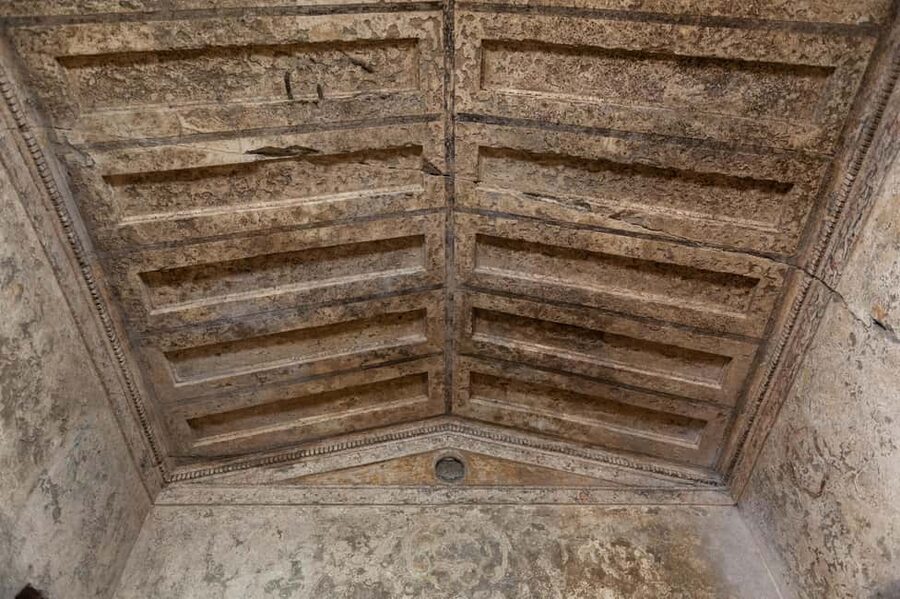
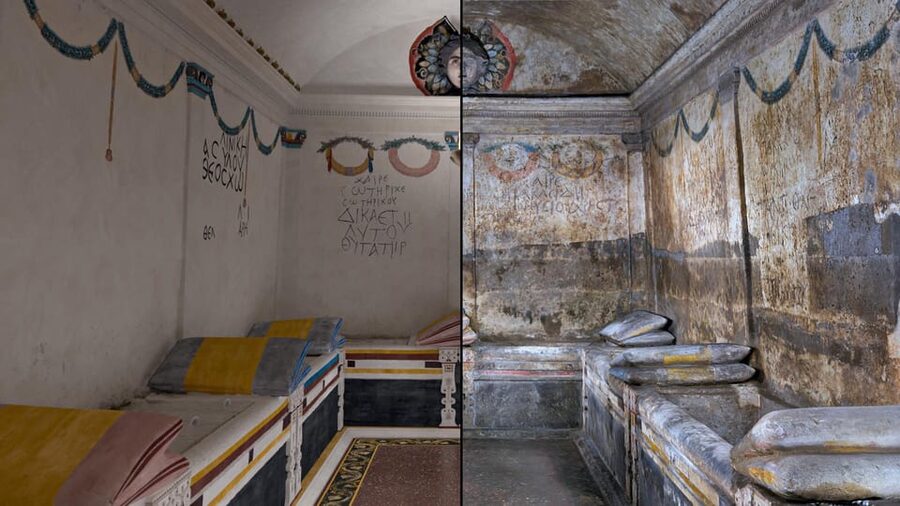
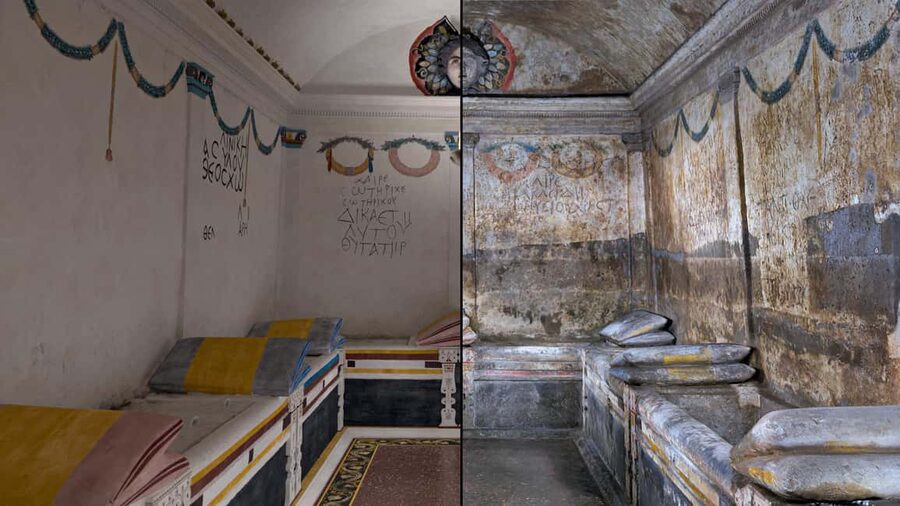
The core experience is a guided walk through the underground Neapolis area, featuring four Hellenistic tombs. You’ll get to see the carved and painted details directly, and the site is presented as being still beautifully preserved. That preservation matters here, because frescoes and painted elements do not always survive well in damp, underground conditions.
As you move through the space, the tour highlights the way the architecture supports the artwork. You’re not just admiring paintings. You’re seeing how stone, layout, and decoration work together as one ancient design.
A key moment is walking the ancient road of Neapolis. Even though this is a short visit, the act of walking the route helps you mentally switch from modern Naples streets to the older street logic underground. That small shift makes the whole experience easier to understand, especially when the guide explains the myths tied to these spaces.
The Medusa That Survives From Greek Naples
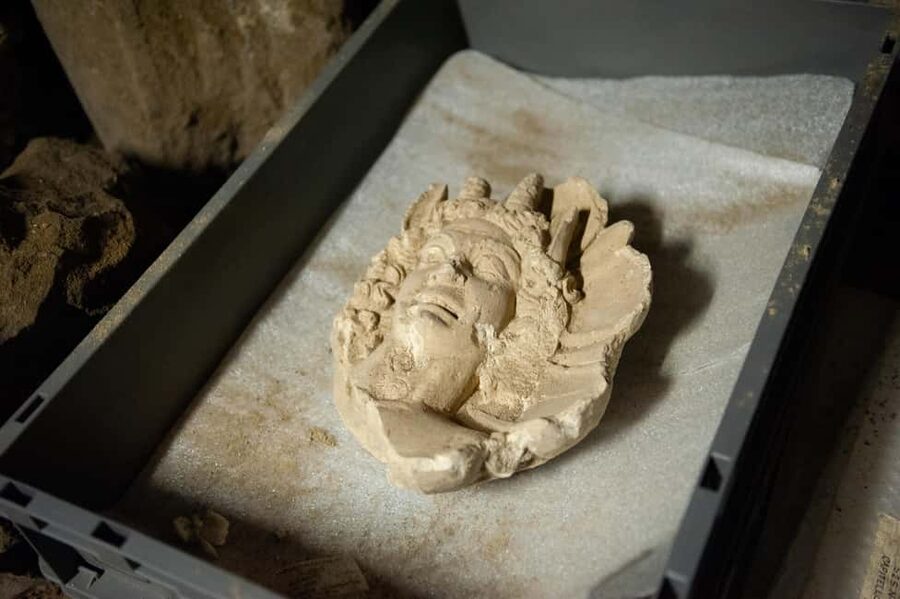
If you’re the kind of person who likes a single “wow” detail, plan to focus here. The Hypogeum of the Crystallines includes a Medusa carved and painted by the ancient Greeks, described as a precious unicum in the world.
This is important for your expectations. You’re not just seeing a decorative motif. You’re seeing an image tied to ancient myth, placed in a painted tomb context. That combination of myth + funerary setting changes how you read the artwork. Medusa becomes more than a spooky face. She becomes part of how people thought about danger, protection, and the passage of life and death.
I also like that the tour doesn’t treat the Medusa as a standalone photo op. The guide’s focus on myths, legends, and the site’s details keeps you connecting the imagery to the larger story of Neapolis and the people who decorated these spaces.
Myths, Roman Additions, and the 1889 Discovery Story
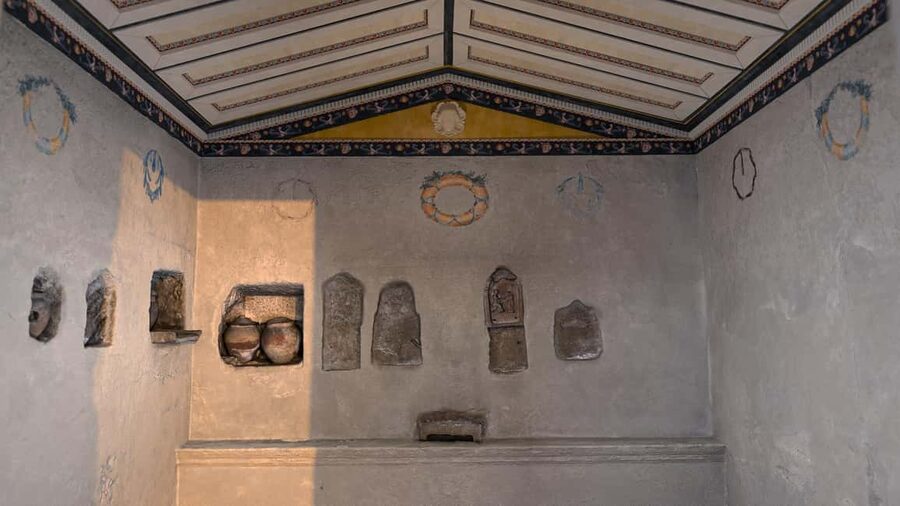
You’ll hear about the discovery of the Hypogeum of the Crystallines, which happened by chance in 1889. The story is tied to Baron Giovanni di Donato, and it gives the visit a satisfying “how we know this exists” arc. Standing underground, you start thinking about what was forgotten, what survived, and how archaeologists and historians eventually brought it back into view.
The tour also frames what you’re seeing as a fusion. You’ll learn how Greek origins meet Roman artistic additions, so the paintings and design elements can reflect more than one cultural layer. That is one of the reasons this site feels more than just Greek or just Roman. It feels like a lived place that changed over time.
Even though the visit is only about 25 minutes, the story angle helps you avoid the common problem of underground sites feeling like dark rooms full of walls. Here, you’re given the myths, and then you’re shown the decorated surfaces connected to those themes.
A different sort of day around the Bay of Naples:
- Naples: Catacombs of San Gennaro Entry Ticket & Guided Tour
★ 4.6 · 7,941 reviews - Naples: Downtown Tour with Veiled Christ & St Clare Tickets
★ 4.9 · 6,462 reviews - Naples: Pizza-Making Workshop with Drink and Appetizer
★ 4.9 · 5,411 reviews - Naples: Hop-on Hop-off Bus Tour 24-Hour Ticket
★ 4.3 · 5,157 reviews
Rione Sanità Context and Why It Matters
One of the more meaningful parts of this experience is not only archaeology, it is the living neighborhood context of Rione Sanità. The tour includes a discussion of the powerful process of sociocultural redevelopment connected to the area.
That doesn’t turn the site into politics class. It simply gives you a reason to care about why this place is being visited and explained now. You’re seeing art from ancient Naples in an area of Naples that still carries strong identity. When a neighborhood invests in protecting and telling its own history, it helps the cultural value of sites like this endure.
You also get a kind of “continuity check.” The ancient world you’re seeing was about community, family, friendship, and the routines of life and death. Then you’re shown how modern Naples is actively shaping the story of that same neighborhood today.
Included Moments That Make the Short Tour Worth It
A standard visit includes a few elements that do real work for your understanding.
First, there is a guide from Rione Sanità who welcomes you to the archaeological site. That matters because the explanations are likely framed around local knowledge, not just textbook facts.
Second, the tour is designed to take you through the fresco details, ancient myths, and architecture rather than leaving you to interpret everything alone. That can be the difference between “cool pictures” and a genuine understanding of what you’re looking at.
Third, you’ll see a video with a virtual reconstruction of the archaeological site. Even if you’re great at visualizing from stone remains, a quick reconstruction helps you place the rooms, streets, and tombs into a more complete mental picture. It also makes it easier to connect what you saw in the underground space to the broader Neapolis layout.
Finally, you’re walking part of the ancient road itself. That physical element is a big deal because it helps the site stop being purely visual and become spatial.
Who This Small-Group Tour Works For (and Who Might Need a Plan B)
This is a small-group experience, limited to 10 participants. In practice, that usually means less crowd pressure and more time for the guide to explain what you’re seeing at each spot. If you like tours where people can hear and understand, this format is a plus.
It is also a good fit for travelers who want a compact hit of archaeology without committing to a half-day or full-day schedule. The total duration is 25 minutes, so it can slot into a busy Naples day.
For families, children aged 8 to 12 are free. Children under 8 are not permitted. That suggests the experience is designed for people who can handle the environment and the pacing.
The one group that needs extra thought is visitors with disabilities. The Ipogeo dei Cristallini has architectural barriers due to its historical nature, and the guidance is to contact before your visit. If you need step-free access, or you get nervous about uneven ground and stairs, plan early.
Price and Value for $11
At $11 per person for a 25-minute guided visit, this is priced like a “high-impact stop” rather than a long, expensive production. You’re paying for access to a specific archaeological site, guided interpretation, and included storytelling elements like the virtual reconstruction video.
What makes it good value is not only the price, it is what you get for the time. You’re shown multiple tomb spaces with preserved painted details, you walk an ancient street, you get myth context, and you have a standout Medusa moment included in the same session. When a short tour includes that many meaningful inputs, it tends to feel fair even if you only have an hour or two to spare.
If you’re trying to choose between spending money on lots of brief attractions or buying one focused experience, this one is strong because it compresses “why this site matters” into a short window.
Practical Tips Before You Go
Here are the small things that help the visit feel smooth.
Wear shoes you trust on stone. You’re descending 12 meters and moving around an underground site, so traction and comfort matter more than style.
Expect a short, structured flow. The visit is listed as 25 minutes, so you’ll want to arrive ready and let the guide set the pace.
If you care about photo timing, decide in advance what you want most: the fresco areas, the carved details, or the Medusa. The tour gives you highlights, but it is not an open-ended wandering session.
Take advantage of the skip-the-ticket-line benefit. That helps if your day in Naples includes multiple stops and you want to avoid waiting around.
Finally, consider language. The tour is offered in Italian, English, Spanish, and French, and choosing your language can help you catch more of the myths and context tied to the art.
Should You Book the Hypogeum of the Crystallines Standard Visit?
Book it if you want a concentrated dose of ancient Naples art with guided myth and a clear sense of place. The combination of well preserved painted tombs, the chance to walk the ancient road, and the included Medusa focus makes this feel more memorable than many standard “see-it-in-a-minute” stops.
Skip it or plan carefully if you need step-free access. The site has architectural barriers, and the guidance is to check in before you go. Also skip it if you hate short tours. This one is only about 25 minutes, so it suits people who like clear pacing.
If your goal is to understand why this part of Naples matters, both in ancient times and today in Rione Sanità, this tour is one of the better uses of a limited schedule.
FAQ
How long is the Hypogeum of the Crystallines Standard Visit?
The visit lasts about 25 minutes. Check availability for the starting times.
How much does it cost?
It is priced at $11 per person.
Where is this experience located?
It is in Campania, Italy.
Is it a small group tour?
Yes. The group is limited to 10 participants.
What languages are available?
The tour is offered in Italian, English, Spanish, and French.
Will I be able to avoid waiting in line?
Yes. The ticket line is skipped.
Is it suitable for children?
Children aged 8 to 12 are free. Children under 8 are not permitted.
Is it accessible for people with disabilities?
The site has architectural barriers due to its historical nature. The guidance is to contact before your visit to assess access possibility.
What is included in the standard visit?
You get a guide from Rione Sanità, a visit focused on fresco details, ancient myths, and architecture, a walk on the ancient road of Neapolis, and a video with virtual reconstruction of the archaeological site.
Recently reviewed around Naples
- From Naples: Pompeii & Mount Vesuvius Full-Day Private Tour★ 4.5 · 4 reviews
- Pompeii with Wine Tasting Private Tour★ 4.7 · 6 reviews
- Pompeii, Amalfi, Ravello Day Tour with Private Transfer★ 5.0 · 3 reviews
- Ruins of Pompeii & the Amalfi Coast: Full-Day Private Tour★ 5.0 · 7 reviews
- Pompeii and Herculaneum: Private Tour from Naples★ 4.6 · 12 reviews
- From Naples: Pompeii Private Tour with Transfer and Guide★ 4.7 · 23 reviews
- Pompei: Private tour of Pompei and Vesuvius from Sorrento★ 5.0 · 8 reviews
- Pizza lesson★ 5.0 · 3 reviews